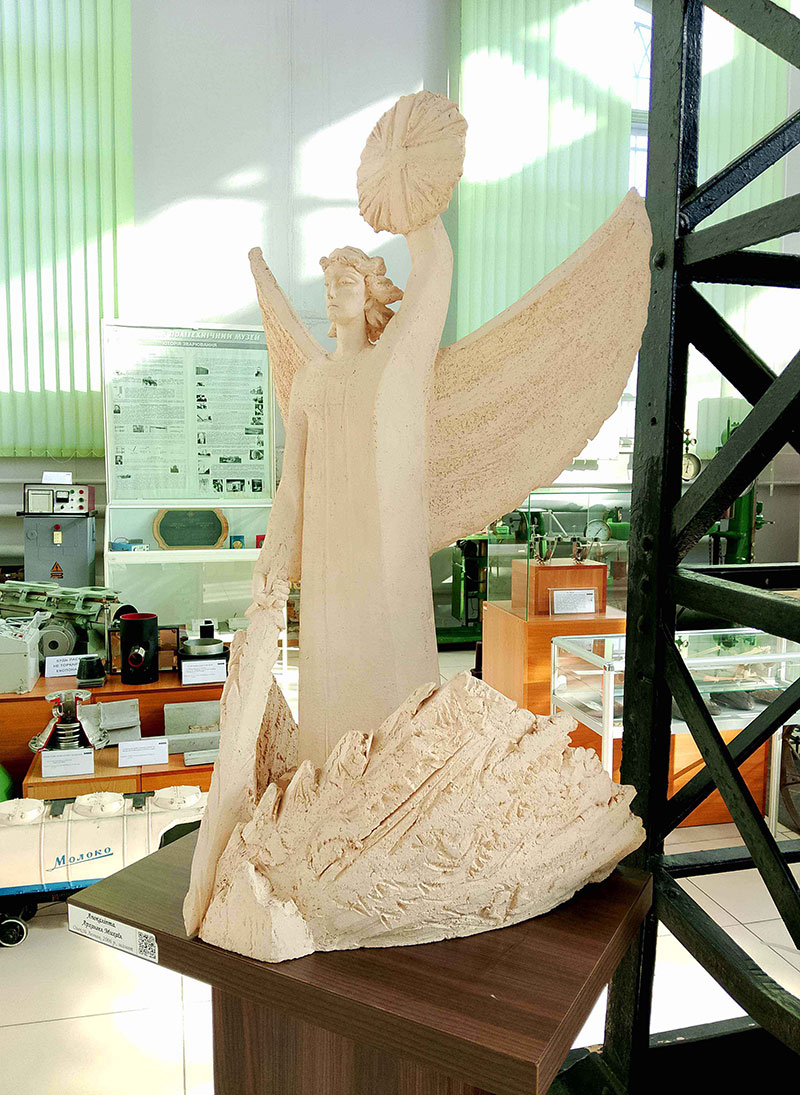

On the Day of Defenders of Ukraine, the Borys Paton State Polytechnic Museum at Igor Sikorsky Kyiv Polytechnic Institute became a meeting place for art, spiritual tradition, and remembrance of those who defend our country. On this day, the museum opened an exhibition of sculptures by renowned Ukrainian artist and Honoured Artist of Ukraine Oleksii Leonov, entitled “The Heavenly Host”.
“October 1 is the Day of Defenders of Ukraine and, at the same time, the Feast of the Intercession of the Holy Mother of God. Our museum marked this date with two events. The first was a concert by students of the Ukrainian National Academy of Music, held as a tribute to all our defenders. The second was the opening of this exhibition,” said Olha Zaichenko, Head of the Research and Educational Activities Department at the Borys Paton State Polytechnic Museum, in an interview with Kyiv Polytechnic.
The opening date was therefore deeply symbolic. The Day of Defenders of Ukraine coincides with the Feast of the Intercession of the Holy Mother of God, one of the most revered religious holidays among Ukrainians. The history of the Ukrainian Cossacks is closely linked to this feast. They regarded the Holy Mother of God, with her omophorion – a symbol of heavenly protection, mercy, and care – as their heavenly patroness, and turned to her for defence and intercession. That is why an exhibition devoted to images of heavenly warriors fits so naturally into the spirit of this day, bringing together historical memory, spiritual values, and a contemporary interpretation of the eternal defenders of humankind – images of particular significance to Ukrainians. Incidentally, among the works on display are several interpretations of Saint Michael the Archangel, the heavenly patron and protector of Kyiv…
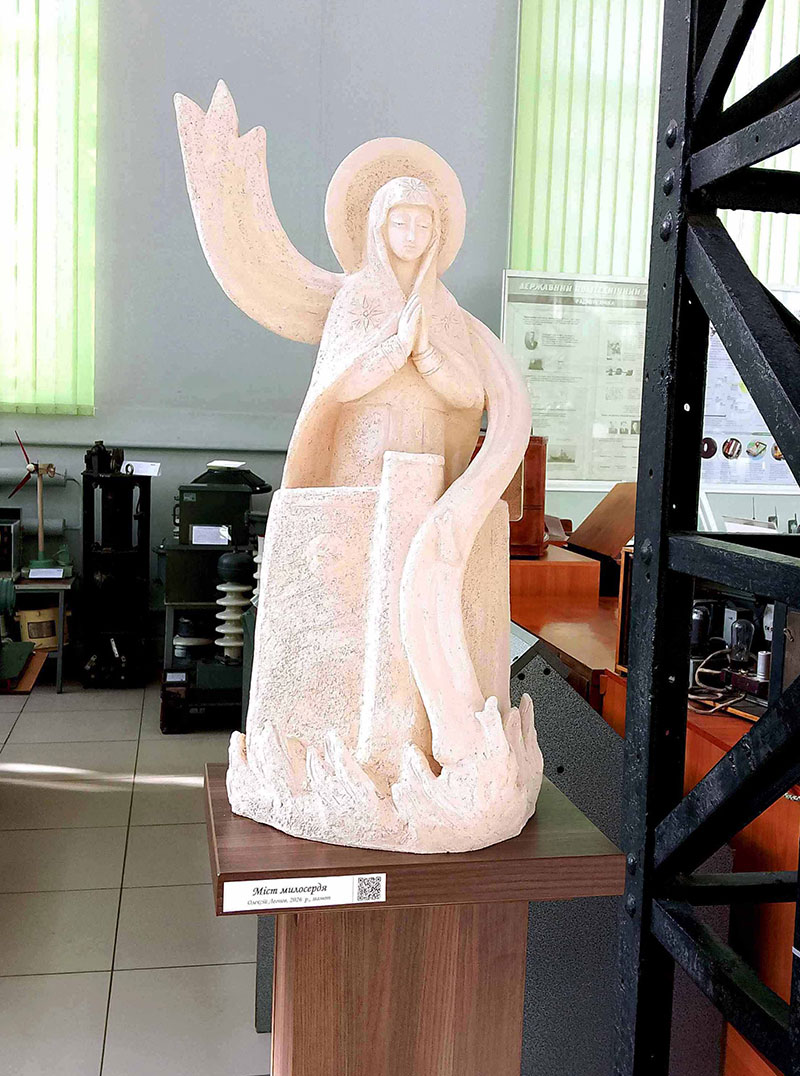
Heavenly Protectors in the Setting of a Technical Museum
The exhibition features six sculptures that reflect the artistic world of Oleksii Leonov. Five are made of chamotte clay, a material with a distinctive texture that allows the artist to explore volume, form, and the character of each image. The sixth is made of a reddish polymer material that seems to glow when sunlight streams through the windows and falls upon it. The sculptures are complemented by photographs of other works by the artist, giving visitors a broader insight into his creative output.
The location of the exhibition adds particular significance to it. Photographs of the sculptures have been placed on the antique openwork trusses in the museum’s largest hall. “We are not an art museum but a technical one. Everything comes together here, as the hall also houses our permanent exhibition. When preparing this exhibition, we had a little disagreement about where to display the photographs of the sculptures,” Olha Zaichenko explained. “The organisers are used to putting them on easels. But from our point of view, that would only clutter the space. In the end, we decided to display them on the trusses.”
During the early years of the Kyiv Polytechnic Institute, this building housed a metalworking workshop. Today, the space has become the main hall of the university’s Polytechnic Museum, home to a remarkable variety of exhibits: historic machine tools, an early-1930s wheeled tractor, models of seagoing vessels and tunnelling equipment used by metro builders, an entire collection of motorcycles, as well as televisions and radio receivers from different periods, among many other objects. Now, the hall is also filled with images that evoke the spiritual dimensions of human existence.
This creates a distinctive sense of the Heavenly Host being present within the museum space. The figures of the protectors seem to extend beyond the exhibition displays and become part of their surroundings. They remind us that the idea of protection is not confined to the battlefield: it encompasses family, education, science, culture, work, and every sphere of public life. For to protect means not only to repel an attack, but also to preserve what society lives for: human dignity, freedom, knowledge, memory, and hope.
For a university museum, this interpretation is particularly meaningful. Igor Sikorsky Kyiv Polytechnic Institute is one of Ukraine’s leading centres of engineering thought, scientific research, and technological achievement. At the same time, any technology acquires its true value when it serves people and society. The art displayed in the museum reminds us of this.
Chamotte: Where Art and Technology Meet
Particular attention should be paid to the material the artist chose for most of the sculptures featured in the exhibition. Chamotte is a refractory material produced by firing fire-resistant clay and then grinding it. It is used, among other things, in ceramic production, the manufacture of refractory products, and artistic ceramics.
However, chamotte is important not only as a sculptural material. Refractory chamotte materials are also used in foundry work, for example, to line furnaces and equipment operating at very high temperatures. They withstand intense heat and provide the technological properties required for industrial processes.
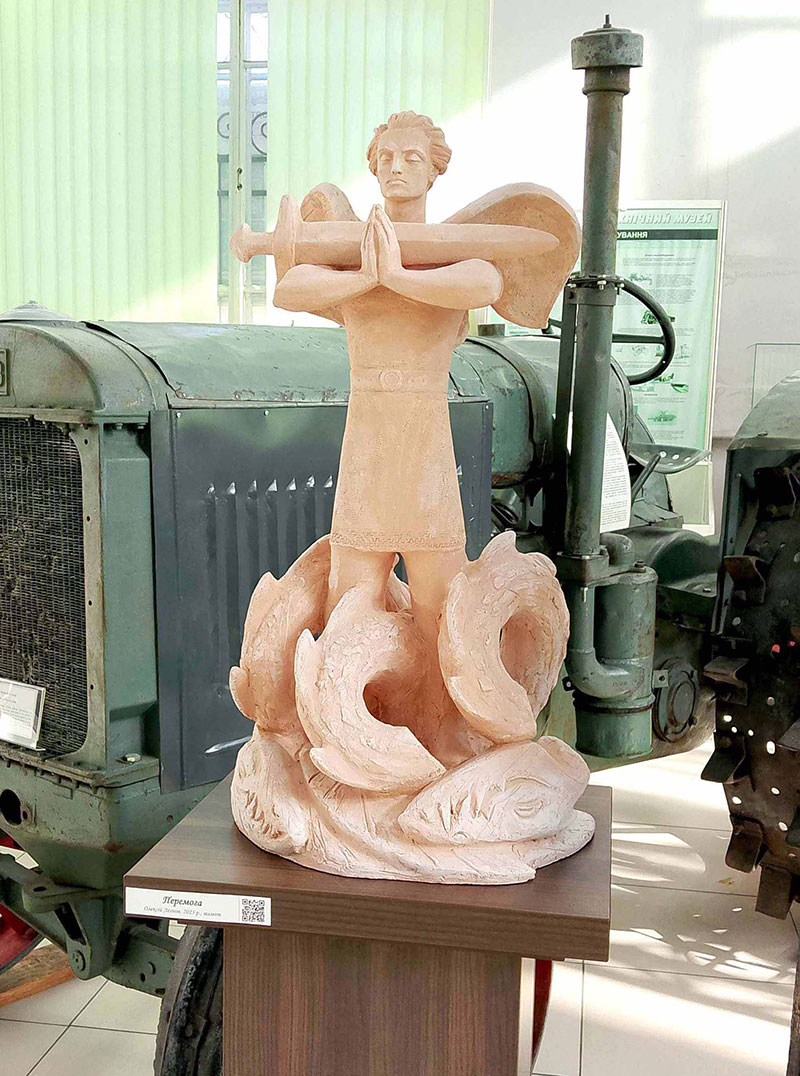
This reveals an interesting affinity between art and technology. In a sculptor’s hands, the material becomes a means of realising an artistic vision; in industry, it helps carry out complex technological operations. In both cases, the outcome depends on knowledge of the material’s properties, an understanding of the process, experience, and human skill.
Yet a work of art cannot be reduced to the material from which it is made. In Leonov’s sculptures, chamotte becomes a vehicle for image and mood, a means of conveying spiritual meaning. Through its plasticity, texture, expressive form, and even its light colour, the material takes on a symbolic dimension. This is where technical knowledge meets artistic intuition: the former makes it possible to master the material, while the latter transforms it into art.
Art as a Language of Spiritual Values
Oleksii Leonov is one of those Ukrainian sculptors whose work places great emphasis on spiritual and philosophical themes. His artistic explorations are rooted in an effort to understand the inner world of human beings and reflect a search for harmony and universal values. In his works, the artist turns to the figures of prominent spiritual teachers, thinkers, and historical personalities, as well as to themes that transcend any particular era or culture.
The title “The Heavenly Host” invites us to reflect on the very concept of a host of warriors. In spiritual tradition, it represents forces called upon to confront darkness and defend goodness. In the context of present-day Ukraine, this image carries particular emotional weight. As the country fights for its independence, freedom, and right to a future, the theme of protection is no longer an abstract metaphor but part of society’s everyday experience.
Of course, the exhibition does not lend itself to a straightforward military interpretation. Rather, it opens up a space for personal reflection, inviting visitors to contemplate courage, responsibility, faith, sacrifice, and inner strength. Each visitor can find their own meaning in the images on display and relate them to their personal experiences and understanding of goodness and justice.
The exhibition will remain open to art enthusiasts until 31 October. It invites visitors not only to discover the work of Oleksii Leonov but also to reflect on what we are called upon to preserve – in our own lives, in society, and in Ukraine.
The exhibition project was organised in cooperation with the Theosophical Society in Ukraine and Bavaria West Private Enterprise.