
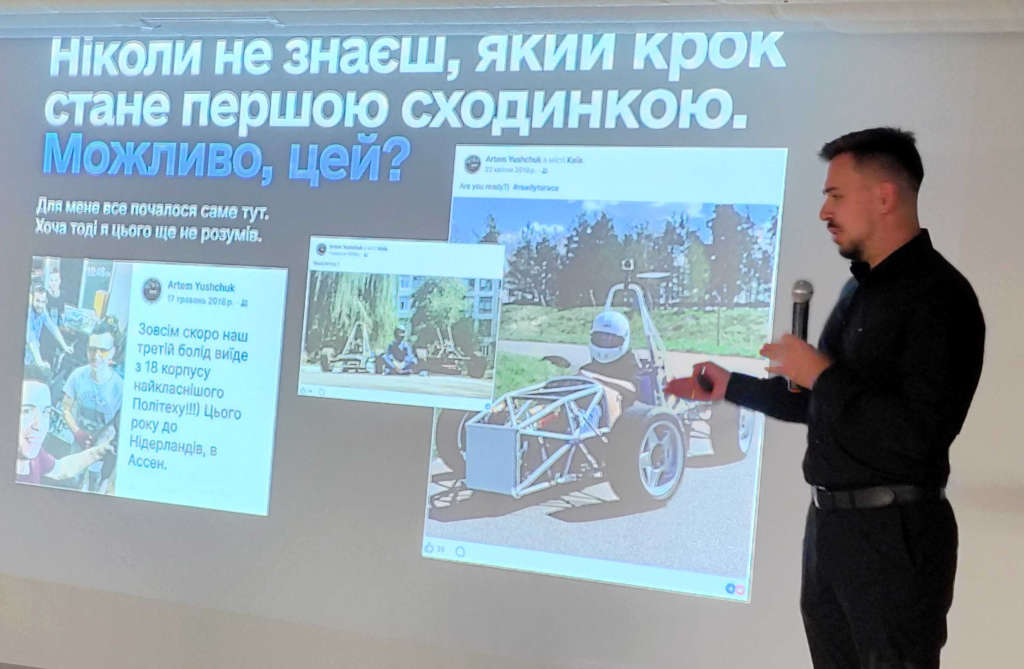
Artem Yushchuk, a graduate of the Educational and Scientific Mechanical Engineering Institute, co-founded a successful Ukrainian manufacturing company with like-minded partners. He is an alumnus of the Formula Student KPI student club, where, under the guidance of Professor Vitalii Pasichnyk, then Head of the Department of Integrated Manufacturing Engineering, students designed and built formula racing cars and competed several times in Formula Student engineering competitions alongside teams from renowned European universities.
Today, Artem’s company manufactures equipment in series to the highest standards and specifications. Its production operations require skilled workers, however. The company’s website regularly lists vacancies ranging from shop-floor positions to engineering roles, with salaries starting at UAH 50,000. Recently, Artem returned to his alma mater to meet with members of the Formula Student club who had passed the selection process and expressed a desire to build another race car at the university. He spoke about his journey at Igor Sikorsky Kyiv Polytechnic Institute and shared his thoughts on what student teamwork focused on achieving a common goal can teach.
“Formula Student isn’t about racing,” he told the audience, gathered in the Smart Shelter CLUST Space at the Scientific and Technical Library. His opening remark was somewhat unexpected. “Racing is just one part of it. Above all, teamwork gives you knowledge and experience: coming up with an idea, calculating and designing it, manufacturing and assembling it, and testing it. You do everything you can to avoid letting your team down. In other words, it’s not enough simply to complete your own task — you need to become part of the team.”
What Artem said next gave the students plenty to think about. “Formula Student changes the way you think,” the entrepreneur continued. “Of course, at the beginning, you lack experience and knowledge. Often, you don’t know how to do something, so you have to find the answer yourself. You need to develop the car’s architecture, design it, and manufacture it. The stages of development are the same as in any other manufacturing company. The difference is that when you enter the job market, you already have specialist skills.” He summed up: “So, it’s not about the car or the racing. It’s about teamwork and responsibility. And responsibility, by the way, will stay with you throughout your life, whatever you do. In our projects, it is absolutely crucial because human lives are at stake.”
The company’s technical director, also an Igor Sikorsky Kyiv Polytechnic Institute alumnus and former member of the student club, spoke about the company’s history and work: “When the full-scale invasion began, we were repairing and upgrading both Ukrainian and foreign-made vehicles. In the process, we noticed various flaws and design decisions that did not work well. You would think that, after years of operation, these designs should have been perfected. Yet when we took the vehicles apart, we found a host of errors that we then corrected. We were just 23 to 25 years old when we came up with the idea of building our own vehicle. We had to knock on many doors in government circles to obtain the technical specifications. But most importantly, we spoke to the people who would actually operate the vehicles and who knew best what they wanted them to be like. We built everything from scratch: the frame, electrical wiring, fuel system, hydraulic and pneumatic systems, suspension, and transmission components. Once we had completed the tests, people began to believe in us.”
During the meeting, Professor Vitalii Pasichnyk, head of the Formula Student KPI club, shared his vision for its work. He emphasized that the project’s primary goal is to turn students’ interest into practical experience and effective teamwork — a process that naturally requires a significant time commitment, including during the summer. He also noted that club members lack hands-on technical skills, so the plan is to launch an internal two-month training programme at the university’s departments, covering various areas of manufacturing, including metalworking, welding, composite materials, and quality control. The mentor stressed that the team captain does not necessarily have to be someone who understands the car inside out. Rather, the captain must be a leader capable of building a cohesive team, motivating others, managing communication, delivering presentations and public speeches, finding sponsors, and taking responsibility for the project as a whole. Accordingly, a mentoring system will remain in place throughout the project, right up to the team’s ambitious goal of competing in an international racing event in late summer 2027.
Speaking about mentoring and sponsorship, Artem Yushchuk explained: “Our goal is for Formula Student KPI to become the strongest engineering team in Ukraine. This matters a great deal to us. Back when we were students, Formula Student gave us so much: connections, the opportunity to learn from our mistakes, the ability to work to deadlines, and, most importantly, experience. Now we have the opportunity to support this project — not only financially, but at every stage going forward: through mentoring, manufacturing, materials, components, and contacts. We will share the knowledge we have accumulated and show you how things should work in practice. Our first Formula Student car was built on a budget of just a few thousand dollars. Over the next few years, our company is ready to invest tens of thousands of dollars and work with you to build one of the best teams in Europe.” This is a commendable initiative that deserves respect, recognition, and emulation!
A successful business must plan for the future, and its leader has a responsibility to think about how to ensure a steady supply of well-trained professionals. “There are many industrial companies in Ukraine that are growing and developing,” Artem Yushchuk told the young people. “Manufacturers need people who have more than just diplomas. A diploma means little if you don’t know how to create things. Knowledge must be put into practice. Skills develop when you combine theory with hands-on experience and gradually begin to grow into engineers.” That is exactly what happens within the Formula Student KPI team.