
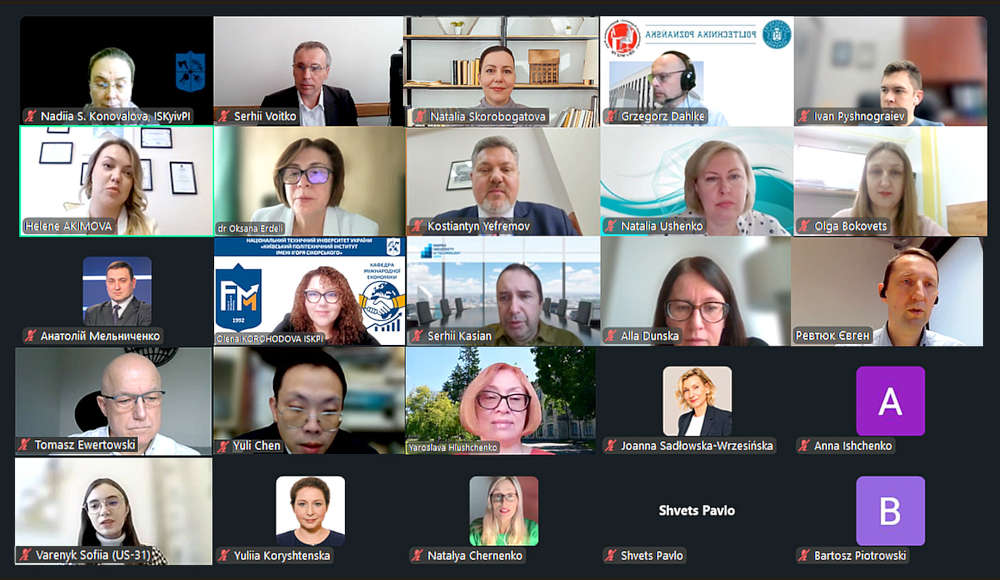
On November 18–19, 2025, Igor Sikorsky Kyiv Polytechnic Institute hosted the international scientific and practical conference “Resilient Communities – Stable Future: Ukrainian-Polish Experience in Crisis Response.” It was dedicated to contemporary challenges facing the functioning of socio-economic systems, ensuring the sustainable development of local communities, and implementing effective models for responding to crisis situations.
The event was held as part of the NATO SPS international grant program “Science for Peace and Security,” project G6119 “Increasing the Capacity of Local Communities to Counteract Crisis Situations.” The project is led by Poznan University of Technology, with our university serving as a partner. The international team of project implementers for CECRS SPS NATO is headed by Oksana Erdeli, an associate professor at Poznan University of Technology. She delivered a presentation titled “Crisis Communication in Local Communities: Findings of the CECRS Project” at the plenary session. Professor Yevhen Revtiuk, Director of the Institute of Management and Computing Systems at this university, presented on the topic: “Understanding Individual Resilience in Crisis Situations: Empirical Evidence.” Grzegorz Dalke analyzed the factors that limit activity in crisis situations. Tomasz Ewertowski presented on assessing the resilience of local communities to crisis situations.
From Kyiv Polytechnic, presentations were given by key project implementers who joined the project at the very beginning of the grant application process and have been carrying out the tasks outlined for each stage from day one. Associate Professor Yaroslava Glushchenko, drawing on her experience in organizing training sessions for students, residents, and government officials in the Bucha district, examined the characteristics of a process-oriented approach within the crisis management system at the local community level. Associate Professor Olena Korogodova focused on the role of youth in community crisis management and serves as a coordinator for research activities. Associate Professor Nataliia Skorobohatova presented on community engagement in developing resilience strategies for sustainable local self-governance. She also organized and handled the documentation for this conference. Associate Professor Nataliia Chernenko delivered a presentation titled “From Crisis to Opportunity: Creating Resilient and Inclusive Communities”; the core of her work lies in developing and validating a management model for “enhancing community resilience to emergencies.” Project fellow and senior lecturer Olga Bokovets highlighted the issue of the psychological readiness of local community residents to respond to crisis situations and focuses on carrying out tasks related to social media communication.
The three-year joint activity under this grant involves studying the ability of decision-makers at the community, regional, or national levels to exert social influence, legitimize authority, and ensure social resilience in crisis management processes in Poland and Ukraine. The project’s goal is to develop principles for improving the effectiveness of the crisis management system in local communities, which must be capable of anticipating negative situations (threats, accidents, disasters) and preparing the necessary resources to address them. Therefore, the conference focused primarily on analyzing the regulatory documents used by local authorities, studying experiences in overcoming crisis situations in Ukraine and Poland, identifying effective and ineffective crisis management practices, and examining the phenomenon of self-organization among local communities, among other topics. The main beneficiaries of the project were local communities in Poznań County, Greater Poland Voivodeship (Poland), and Bucha District, Kyiv Oblast (Ukraine).
The conference was opened by Anatolii Melnychenko, Rector of Igor Sikorsky Kyiv Polytechnic Institute. Leaders and researchers from the Educational and Scientific Institute of Applied and Systems Analysis at KPI, the Faculty of Management and Marketing, and the Faculty of Sociology and Law actively participated in the event. Over the course of two working days, 26 presentations were delivered by participants from Ukraine, Poland, Romania, and China. Applications for participation were submitted by 37 participants (in addition to the countries mentioned, there was also an application and presentation materials from the Czech Republic). The event was well-attended, with 87 unique participants recorded for the Zoom conference, 65 of whom were online simultaneously.
The conference’s thematic areas were as follows: “Ukrainian realities regarding society’s capacity to respond to crisis situations,” “The resilience model: how Polish municipalities are adapting to new challenges,” “Good governance and digital resilience of communities,” and “Data science for countering threats to community development.”
Based on the results of the abstract review, two sections were formed: “Building Society’s Capacity to Cope with Crisis Situations” and “Community Governance: Anti-Crisis Models and Resilience Modeling.”
During the conference, issues of community governance in wartime, the population’s psychological preparedness for emergencies, crisis communication, digital transformation, and strategies for ensuring local security. Attention was also focused on strengthening social cohesion, crisis communications, adapting management models, and building resilient social systems during times of war and global challenges.
In conclusion, it should be noted that an important component of our activities is promoting international support for Ukraine’s efforts to achieve victory. And the conference demonstrated that the international community is aware of the existential threats to humanity with which we are closing out the first quarter of the 21st century.