
Mathematics has long been regarded as the queen of the sciences—a universal language understood by researchers across the world and the foundation of the exact sciences. There is little need today to explain the importance of mastering at least its fundamentals, especially in a world increasingly shaped by advanced technologies.
Yet mathematics education in Ukraine is facing unprecedented challenges as a result of the ongoing war. Chronic stress and persistent technical disruptions have undermined students' cognitive abilities and the systematic development of their knowledge. Learning losses and the simplification of school curricula, particularly following the introduction of the National Multi-Subject Test (NMT), have further weakened the culture of logical thinking. Under these circumstances, studying mathematics has become far more than learning formulas and rules—it is a vital effort to preserve the intellectual potential of the younger generation in exceptionally difficult conditions.
To demonstrate to school students just how fascinating and valuable mathematics can be, Igor Sikorsky Kyiv Polytechnic Institute, together with the Junior Academy of Sciences of Ukraine (JAS), has organized nationwide celebrations of International Pi Day for four consecutive years. This year, however, the organizers decided to go beyond the walls of a university classroom and embarked on a genuine Spring Mathematics Expedition, visiting students at several secondary schools across Kyiv.
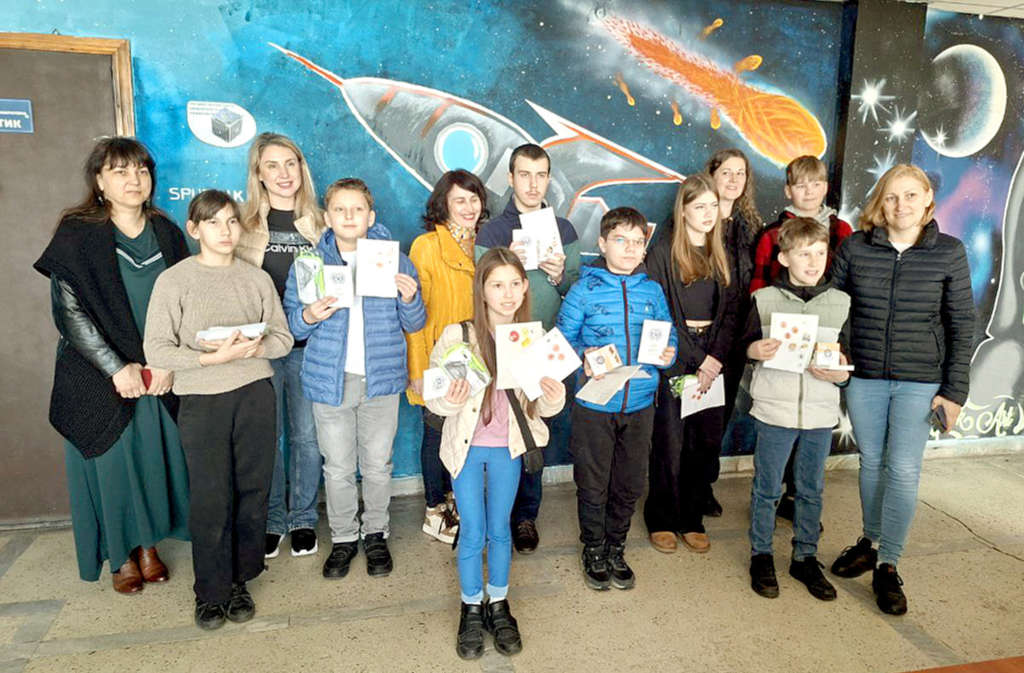
On February 26, as part of the Mathematics Days with Igor Sikorsky Kyiv Polytechnic Institute program, students of Dominanta Lyceum in Kyiv's Dniprovskyi District were given a unique opportunity to look behind the scenes of "big science." The central idea of the event, titled Mathematics Without Formulas, was to show students that mathematics is far more than pages filled with formulas, complex graphs, and diagrams. Instead, it is about flexible thinking, the ability to recognize hidden patterns, and the search for elegant solutions to unconventional logical puzzles. Each challenge required much more than memorized formulas and rules—it called for creativity, original thinking, well-reasoned arguments, and effective teamwork.
On March 12, a series of professional webinars brought together more than fifty school teachers and actively engaged parents. The discussions focused on the topics Research as a Tool for Inspiring Interest in Physics in Secondary Education and How to Engage Humanities-Oriented Students in Mathematics. Participants explored teaching approaches that transform conventional classroom instruction into an authentic research experience, fostering students' genuine curiosity about physical phenomena and scientific inquiry.
The webinars provided participants with practical teaching resources and methodological case studies designed to turn the study of mathematics and physics into an engaging process of discovery. These materials help students uncover the relevance and meaning of the exact sciences, enabling even the most dedicated humanities-oriented learners to appreciate the beauty of mathematical and physical structures, develop a desire to understand fundamental concepts and laws, and experience the satisfaction that comes from genuine intellectual discovery.
Also on March 12, Kyrylivskyi Lyceum No. 17 in Kyiv's Podilskyi District hosted the Mathematics Relay, bringing together around 50 enthusiastic students. Eight teams, each consisting of six to eight participants, tested their own "formula for success" in an atmosphere of genuine intellectual excitement. The main challenge lay in developing an effective team strategy and making quick decisions under intense time pressure.
Another event, Mathematical Miniatures, gathered more than 20 of the strongest seventh-grade students from Potentsial Lyceum in Kyiv's Obolonskyi District. Working in small teams, they tackled a wide variety of problems in algebra, geometry, logic, and graph theory. Victory did not go to those who had simply memorized formulas, but to those who remained calm under pressure, identified creative solutions to challenging logical puzzles, and earned the highest scores for their teams. The competition demonstrated that mathematics is a field where bold ideas, critical thinking, and effective collaboration go hand in hand.
On March 13, Lyceum No. 156 in Kyiv's Vynohradar district was transformed into a hub of intellectual adventure. More than 50 students from three classes of the same grade level took part in the engaging Mathematical Kaleidoscope quest. Working in teams, they competed to solve 30 diverse challenges covering logic, algebra, and plane geometry. Each stage of the quest demanded quick thinking, sound reasoning, and effective teamwork. Participants explored everything from elegant geometric patterns to complex numerical relationships, while their creativity and enthusiasm helped them navigate intricate logical puzzles and uncover their hidden solutions.
Later that same day, a workshop for 10th- and 11th-grade students titled Solving Parameter Problems in the National Multi-Subject Test (NMT) provided an intensive introduction to one of the most challenging components of the examination. Held via Zoom, the event attracted more than 200 registered participants, highlighting the strong interest in this topic among prospective university applicants. Experienced lecturers from the Faculty of Physics and Mathematics of Igor Sikorsky Kyiv Polytechnic Institute transformed what many students consider the most intimidating mathematics problems into clear, structured solution strategies aimed at maximizing NMT scores. Participants learned how to identify solutions using graphical approaches and how to apply the properties of functions effectively when solving parameter-based problems through analytical methods.
This year, the Faculty of Physics and Mathematics also organized the Space Journey quest game, dedicated to the number π and its role in science and navigation. Faculty members and first-year students designed a themed quest featuring a series of mathematical "stations" for visiting school students. Participants solved creative problems in logic, arithmetic, and algebra that simulated the challenges of piloting a spacecraft. Successfully modeling real-world processes allowed them to move on to hands-on physics activities, demonstrating how theoretical concepts are applied in practice. The most memorable part of the event was undoubtedly the spectacular physics demonstrations. Students revisited Archimedes' principle, observed the diffraction of light through a diffraction grating, and were amazed by the wireless illumination of light bulbs. These live experiments in energy and optics transformed complex scientific concepts into engaging, accessible experiences, inspiring even the youngest participants to pursue their own scientific discoveries.
On March 14, the Third All-Ukrainian Scientific Pi Conference took place as part of the nationwide Physics and Mathematics Month From the Number π to Planck's Constant h. The central theme of this year's conference, Mathematics and Hope, emphasized that mathematics is not only the language of science but also a powerful tool for understanding the world, solving complex problems, and shaping the future. Mathematical ideas help predict climate change, drive technological innovation, advance medicine, and optimize transportation and communication systems. In times of uncertainty, mathematics becomes a source of rational thinking, innovation, and confidence that even the most difficult challenges can be addressed through knowledge and creativity. The student research competition held within the conference demonstrated both the high level of preparation of the participants and the outstanding quality of the projects presented.
On March 18, the interdisciplinary quiz competition From Archimedes to Planck, organized by Igor Sikorsky Kyiv Polytechnic Institute in partnership with the Institute of Mathematics, transformed traditional learning into a dynamic intellectual challenge for students in grades 7–9. Bringing together mathematics, physics, biology, geography, chemistry, and other natural sciences, the event demonstrated how these disciplines are united by the power of logical reasoning. The atmosphere was one of intense concentration. As soon as the one-minute timer began counting down, each team immersed itself in solving unconventional questions that could not be answered through memorization alone. From the great scientific discoveries of the past to the challenges of modern science, participants learned to compare facts rapidly, defend their hypotheses with sound arguments, and recognize connections between ideas with remarkable speed.
The organizers of Mathematics Days hope that these celebrations will continue to become an annual tradition, fostering the well-rounded development of younger generations and attracting an ever-growing number of participants with each new extracurricular event—ideally increasing at a truly geometric rate.
Congratulations to all the winners! We look forward to meeting participants again at future intellectual competitions and mathematical challenges.
In this context, it is also worth mentioning the mathematics-themed quest held at the State Polytechnic Museum of Igor Sikorsky Kyiv Polytechnic Institute, which is featured in another article in this issue.