
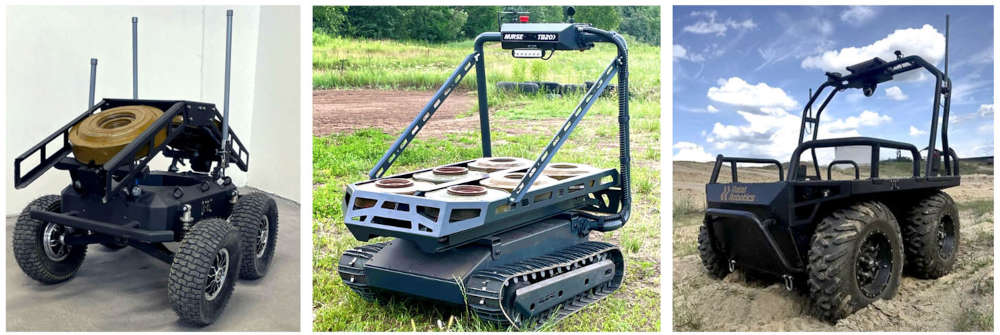
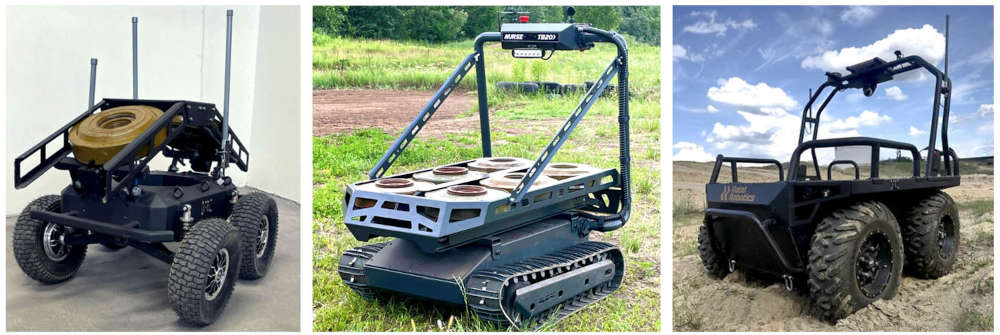
Modern warfare is not only a confrontation between manpower and technology, but also a battle between robotic technologies. Today, unmanned systems perform a wide range of tasks: from reconnaissance and combat operations to rescuing the wounded and delivering provisions and ammunition. And we are not only talking about UAVs, but also ground-based robotic systems (GRS), which were created with the help of the hands, minds, and knowledge of Kyiv Polytechnic Institute students.
What they can do. “NRK does not get tired, does not panic, and does not hesitate,” experts say. That's right, because modern NRK are highly specialized systems capable of performing important tasks on the battlefield. Combat GRCs, armed with machine guns and grenade launchers, are already storming enemy positions and firing at the enemy from a distance that is safe for the operator. Reconnaissance vehicles equipped with day/night vision cameras, thermal imagers, radars, etc. are designed to detect enemy concentrations without risk to soldiers. Engineering and sapper NRK neutralize explosive devices/mine territories, clear debris. Another important mission of NRK is the evacuation of the wounded and the performance of logistical tasks: transportation of ammunition, water, medicines, removal of cargo from under fire, etc. But most importantly, they replace humans in dangerous areas and help save the lives of military personnel. Today, 99% of robots on the front lines are Ukrainian-made: 47% are logistics and evacuation complexes, about 25% are engineering complexes, 12% are combat complexes, and the rest are special-purpose complexes.
Their ancestors. Researchers provide detailed information about the predecessors of today's combat assistants. Their history is not very exciting, but it is consistent, as the military has always sought to harm its enemies while preserving the lives of its soldiers.
During the Roman Empire and the Middle Ages, soldiers used carts and other vehicles, which they set on fire or loaded with stones and directed at the enemy to cause panic in their ranks.
But full-fledged prototypes only appeared during World War I. At that time, the Germans began to create remotely controlled machines that carried explosives instead of suicide soldiers. And in World War II, they introduced the Goliath, a small tracked device that was remotely controlled and carried 100 kg of explosives to an enemy tank or dugout. During the Cold War, the USSR and the US created remote-controlled tanks to operate in the event of a nuclear attack. And in the 2000s, the first “smart” sappers, PackBot and TALON, entered the battlefield, saving lives in Iraq and Afghanistan.
However, military engineers emphasize that the real breakthrough in this field has undoubtedly occurred in recent years, after the start of the Russian-Ukrainian war. According to Defense News forecasts, by 2030, the share of UGVs in NATO combat operations could reach 30%. The Ukrainian army is testing a number of robotic systems in combat operations: from remotely controlled platforms for evacuating the wounded or delivering ammunition to experimental ground attack drones. They are mounted on tracked or wheeled chassis, operate in virtually any weather, are capable of covering significant distances, are equipped with secure communication channels, and remain operational in conditions of electronic warfare, unstable communications, physical obstacles, and shelling. In addition, most Ukrainian platforms are modular, allowing for quick changes in weaponry or purpose depending on the task at hand. AI plays a key role in ensuring that such devices operate effectively, reducing the burden on the operator and working autonomously.
Reality. Both private manufacturers and volunteer associations are actively working on the development of robotic systems in Ukraine. According to the First Deputy Prime Minister of Ukraine – Minister of Digital Transformation Mykhailo Fedorov, more than 200 domestic companies manufacture robots, and more than 40 developments are codified according to NATO standards. “Robots should fight, not people,” he emphasizes.
Among the manufacturers is Ratel, a company founded by KPI graduate Taras Ostapchuk. “Ratel is not just a company for me,” he shares. "It is the result of a journey that began within the walls of KPI. It was the institute that gave me fundamental knowledge, taught me to think systematically, and combine science with practice. Here I realized that real change happens when ideas from the classroom are turned into real projects."
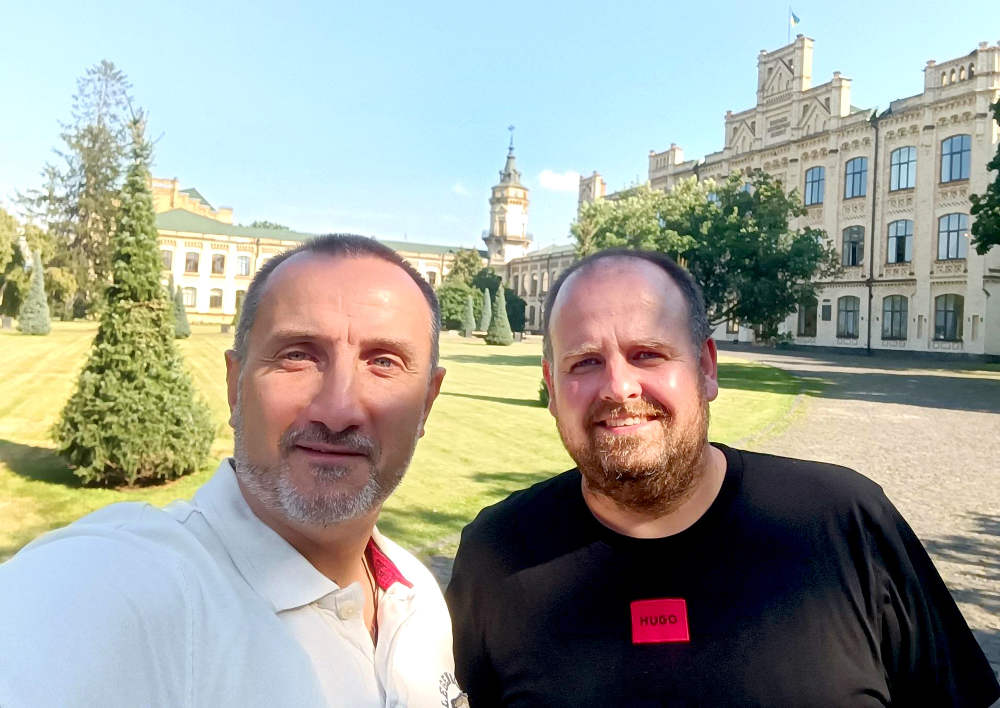 In the photo: Taras Ostapchuk and Andriy Gavrushkevych
“He directed the knowledge, skills, and experience he gained as a technician and soldier toward the creation and development of NRK,” says Andriy Gavrushkevych, assistant to the rector for veteran policy, introducing his colleague. "Taras founded a high-tech company that quickly became one of the top manufacturers in Ukraine. The products have proven themselves on the battlefield in top units with a wide range of tasks performed. Taras Ostapchuk represents Ukraine with dignity at international exhibitions. The company, which employs many veterans and KPI graduates, is actively developing and improving. It has been included in Forbes Next 250, a ranking of the most innovative and promising companies that are shaping the future. It is nice to see such dynamics."
Ratel robots. The company specializes in the development of robotic systems for various purposes that are in demand on the market. In particular, Ratel robots can work as kamikaze drones, perform the work of sappers, as well as transport cargo and evacuate the wounded.
By the way, what is a ratel? It turns out that it is not a thing, but a person. “According to the Guinness Book of Records, the most fearless animal in the world is the honey badger. This beast, also known as the bald badger or ratel, is distinguished by its aggressiveness, fearlessness, and resistance to poison, in particular cobra venom,” the company explained. That's what it is — the badass of the animal world, a small but ferocious beast. The most fearless animal.
“Before the full-scale invasion, we were involved in professional street lighting,” says Taras. “But the treacherous attack by the accursed enemy on the territory of Ukraine forced us to change our line of business.” And they started from scratch to develop technologies that take on the most difficult tasks on the battlefield. The first robot was the Ratel S, which they had been working on since December 2022. In March 2023, it passed testing, and in May, serial production began. “The combat armored Ratel S is a kamikaze robot designed to destroy enemy equipment and personnel,” the developer continues. "The drone can also destroy communications, for example, a bridge in the village of Ivanivske in Donetsk Oblast, which complicated Russian logistics in the Bakhmut direction. Under the cover of the Ratel, operations were carried out in the Kharkiv direction, in Avdiivka, and in Orikhiv. In November 2023, we made a superstructure for it, and the kamikaze robot also became a remote miner. It can carry 35 kg as a kamikaze, and two anti-tank mines when used for remote mining.
The company's developments also include the Nurse TB robotic logistics complex with a payload of up to 150 kg; the Ratel M robotic complex for evacuation and logistics tasks with a payload of over 200 kg; the Ratel H robotic complex for multi-purpose use with a payload of over 400 kg. It can also pull up to 1,500 kg and, thanks to infrared headlights and night vision cameras, works even at night. It will be in series production from July 2024. "In the event of an unforeseen situation, we lose the robot, not a person. The same applies to ammunition. To transport 400 kg over 5 km, five people would have to run all night. Instead, a robot can be sent. In the event of an attack, we lose one robot, not five people," says Taras Ostapchuk.
It should be noted that the company is interested not only in production, but also in the effective operation of its machines. To this end, operators are trained, including at the training ground; repair workshops are set up near the front line, constant contact is maintained with the military, and their wishes are taken into account when modifying the platforms. Incidentally, despite their apparent simplicity, they are quite expensive. For example, one Ratel S costs from $25,000.
Recognition. In July, Istanbul hosted the IDEF international defense exhibition, where nearly a thousand local and over 400 foreign companies showcased their products. It was attended by thousands of specialists from dozens of countries looking for reliable partners, cutting-edge technologies, and breakthrough solutions. Among the exhibits was the Ratel robot. “Our Ratel stands among the flashy weapons on display,” says company CEO Taras Ostapchuk proudly. "But unlike most of them, this one has already been under fire. It has seen FPV (it was attacked by FPV drones on the front line — Ed.). It has seen minefields. It replaces people on the battlefield. We didn't bring it here to show off. We brought it to show that Ukrainian robots are already accomplishing tasks that other countries haven't even begun to explore in PowerPoint presentations. It's not a concept. It's not a prototype. It's a combat robot that gets the job done."
In August, the Ratel Robotics team took part in the first Ukrainian Technological Sports Championship. “Our ground-based robotic systems took to the track alongside the country's leading pilots and engineers, demonstrating the practical capabilities of modern technologies in real-world tests. And we have the result: 1st place in the ‘mining’ discipline!” the company said.
 In the photo: A combat robot that does the work
Together with KPI. "Today, Ratel Robotics is developing ground-based robotic systems that help our soldiers and save lives on the front lines. We are open to cooperation with KPI: we take students for internships and jobs, give them the opportunity to gain real engineering experience and contribute to the creation of technologies that are already working on the battlefield today. Although we are not actively recruiting at the moment, you can leave an application on the website or send your resume by email today—we keep all contacts and return to them when we need new people,“ said T. Ostapchuk. ”I also want to appeal to students: use your study time as effectively as possible. Don't put off your ideas until later; try to implement them now. Even a small step during your student years can become the basis for a large project in the future. Science and practice should not be separate spheres – it is their synthesis that gives real results."
Bringing the future closer. On Independence Day, Ukrainian arms manufacturers showed their EU and NATO partners technological solutions that enable them to defend the country right now. Among the innovations presented was the Ratel robot. “Ukraine produces innovative products that change the situation on the battlefield and can defend global security,” M. Fedorov emphasized at the time. Indeed, Ukraine is introducing a new model of warfare. "Drones, electronic warfare, communication systems, and NRK are no longer the future, but the reality of the modern front. Armies around the world are studying our experience because we are applying what exists in the world only as a project,“ the military states. ”The future of Ukrainian technology is being born here and now. And I am confident that you, the students of KPI, will be its creators," the innovative entrepreneur addresses the polytechnic students.