
Hi! My name is Mykyta, and in this article I want to share my story: how I chose engineering, entered Igor Sikorsky Polytechnic Institute, and embarked on a journey that, although still relatively short, has already been quite an interesting one.
As I mentioned, I am a student at Igor Sikorsky Polytechnic Institute. I study at the Educational and Research Institute of Mechanical Engineering, or “MIMIMI,” as I jokingly call it, because, well, it just sounds adorable, at the Applied Fluid Mechanics and Mechatronics Department. I think that’s enough about the formalities for now.
I am currently completing my bachelor’s degree in Applied Mechanics, specializing in Automated and Robotic Mechanical Systems. Over these four years of student life at Igor Sikorsky Polytechnic Institute, I have gained quite a bit of experience that I can now share.
Why Engineering?
My decision about pursuing higher education was quite well considered. Before entering Igor Sikorsky Polytechnic Institute, I graduated from an automotive and road construction vocational college. Even earlier, back in my school days, I was constantly taking apart calculators, remote controls, and pretty much anything that had at least a few screws inside. I have always been interested in technology, especially mechanics. So after completing my basic and vocational education, it made sense to continue in the same direction and pursue a university degree in a field I genuinely enjoy.
Is It Difficult to Study Engineering?
Studying at the Educational and Research Institute of Mechanical Engineering is not exactly extremely difficult, but it is not a walk in the park either. As they say, the main thing is to actually enjoy what you are doing. Based on my observations of my classmates, the most challenging subjects are usually the fundamental engineering disciplines, such as higher mathematics, fluid and gas mechanics, and, of course, our holy grail—strength of materials. The main reason is that you need a solid understanding of mathematics, and that can be difficult for many people.
In reality, you do not have to be a mathematical genius to become an engineer. Higher mathematics is relevant mainly to a limited range of subjects within certain specializations. Engineering is, first and foremost, about creativity—of course, creativity backed up by calculations. Not every mechanism can be designed using formulas alone, but knowing the basic principles of engineering calculations significantly reduces the number of iterations needed to arrive at the “perfect” concept. You start to develop an intuition for where a structure needs reinforcement, where excess material can be removed to make a product lighter, and so on.
Practical Experience for an Engineering Student
My classmates are smart and passionate about engineering, but all of us noticeably lack practical experience. And without it, it is difficult to make the right technical decisions. What do I mean? You cannot develop a device that is both technologically efficient and economically viable without understanding how it is actually manufactured in a real industrial setting. That kind of knowledge comes only with experience, so you need to get as much of it as possible.
Now, a few words about practical classes at the university. Fortunately, there are quite a lot of them. All the subjects I mentioned earlier include practical components in addition to lectures, and these are graded separately. We actually worked with our hands: we assembled engines, built pneumatic and hydraulic circuits, and programmed process-control systems—all in laboratories based at the departments. And for that, I am very grateful to our instructors, because preparing such a large number of practical assignments is genuinely demanding and resource-intensive work.
I remember how, starting in our third year, we would spend hours putting together simple pneumatic or electrical circuits. By our fourth year, we were already amazed at how quickly we could keep up with our instructors. We had gained practical skills, our thinking had adapted—and things just started to click.
Without access to a real industrial environment, you simply do not know how to apply these skills in real life. That is why I believe that if you have an opportunity to get an internship, take part in a hackathon, or work on a project with a real client—go for it. It is invaluable experience that will keep you from getting lost in theory.
Projects
It seems to me that you simply cannot find as many student projects as we have at the Educational and Research Institute of Mechanical Engineering anywhere else. There is “Formula KPI,” a student group that used to design and build its own race cars but has now shifted its focus to developing ground-based systems for military applications. There are also bioengineering groups where students can literally “break” a bone—to study how it can best be stabilized in the event of a fracture and which materials should be used for implants.
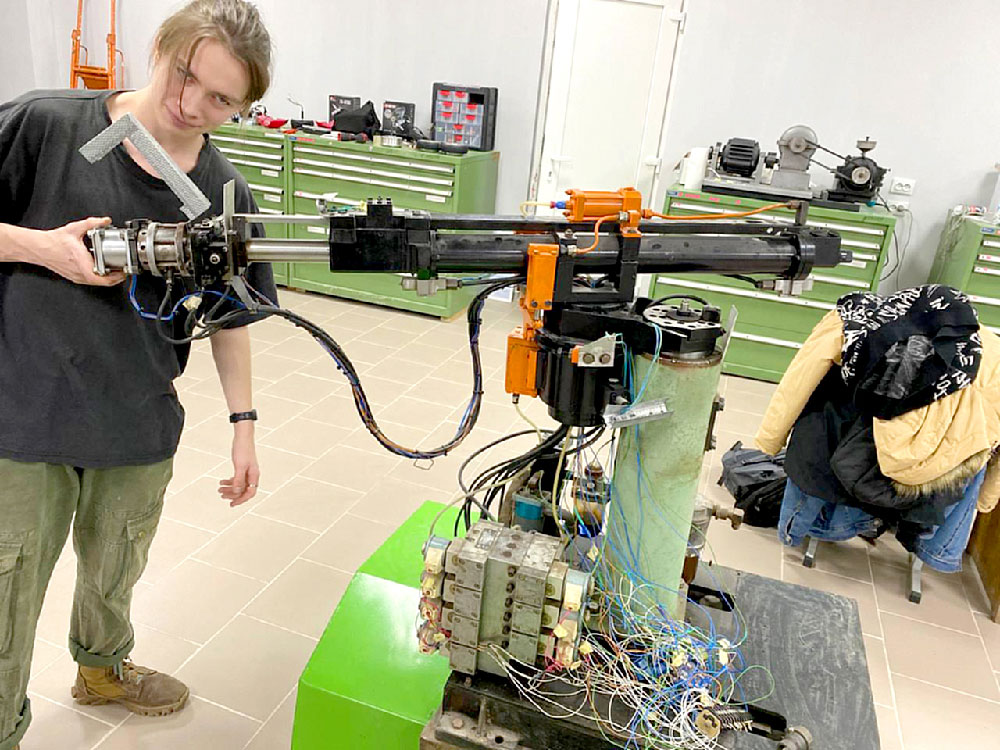
Personally, I worked on restoring an old but robotic pneumatic manipulator (pictured). It was a decommissioned pneumatic robot that had been sitting unused in one of the institute’s laboratories for years. Then we were offered a controller—a sort of “brain” for the device. I put together a team of like-minded people, and we took on the restoration project.
The work was genuinely fascinating because we had to figure out a huge range of things, from electrical systems to the design of pneumatic components. The robot was constantly “leaking” air from every possible gap and, as a result, refused to work. We learned how to locate and fix leaks, test individual mechanisms, reconnect the electronics—in short, we went through the entire engineering restoration cycle.
These days, I take part in projects less frequently because I am busy with work and writing my bachelor’s thesis. However, I am always happy to help others as a consultant when someone comes to me with technical questions about mechanisms or design solutions. It helps me stay “in the loop” while also passing on the experience I have gained.
What Internship Opportunities Are Available?
Hackathons, courses, and educational programs are held regularly, both on the initiative of student organizations and with the support of well-known companies. Businesses are actively interested in young professionals, so representatives of companies such as MHP, Ajax Systems, Melexis, and others often visit our alma mater. They not only sponsor events but also organize courses that can lead to an internship or even a first job.
One of the most recent initiatives I took part in was the Ajax Next mechanical design engineer course. Let me tell you a little more about it.
Ajax Next is a unique opportunity to learn directly from specialists who develop cutting-edge engineering solutions in the field of security. Ajax Systems specializes in developing security systems, automation solutions, and IoT devices, while its engineers are leading specialists in mechanics, electronics, programming, and manufacturing.
The Ajax Next courses give young professionals an opportunity to:
– learn the fundamentals of designing IoT devices;
– understand how such devices are manufactured;
– explore the design of complex molds and the processes involved in mass production.
Most importantly, after completing the course, students have an opportunity to take part in an internship or even receive a job offer. And for young engineers, this is extremely important—not just to gain knowledge, but to put it into practice right away.
There are actually many internship opportunities at the institute. The key is simply to be willing to take part in these initiatives. Yes, traditional industrial internships are somewhat limited, but the active involvement of major companies partly makes up for this shortcoming. They open their doors to students, give them opportunities to work on real projects, and help shape a modern culture of engineering education—and that is certainly something to be happy about.
What Is the Atmosphere Like at the Institute?
It is friendly, yet at the same time charged with a drive to grow and develop. This is not a place where you simply “sit out” four years. It is a place where everyone—from students to instructors—is united by a common goal: to create, invent, and improve. If you do not know something, people here will help, give you advice, and show you how it works. Initiative is valued, those who seek new solutions are respected, and everyone who wants to grow is supported.
Sometimes the atmosphere feels like a startup incubator, where ideas are constantly buzzing around in your head while you have a wrench in one hand and a laptop running CAD software in the other. And that is probably the best thing that could happen to you as a young engineer.
 In the photo: At the Ajax Next courses
 Is It Worth Becoming an Engineer Today?
When we talk about mechanical engineers, many people immediately picture a stereotypical image: a burly man in dirty work clothes, holding a wrench, with a noisy machine in the background. But that image has long been outdated. A modern mechanical engineer is, first and foremost, a highly qualified professional who spends most of their time working at a computer rather than at a machine tool.
Most engineering work today is carried out in a digital environment. We design mechanisms using CAD systems such as SolidWorks, CATIA, and Inventor; perform calculations using CAE software; simulate the operation of complex systems; analyze loads; and optimize designs for 3D printing or automated manufacturing. This is no longer manual labor—it is intellectual engineering based on digital tools.
Unfortunately, you can still hear people say, “Engineers are no longer needed; everything is moving into IT.” To be honest, statements like this genuinely frustrate me. They are not only wrong but also reflect a misunderstanding of the modern world. Engineers are the people who create the foundation on which IT depends. Computers, servers, smartphones, data centers—all of these are designed and manufactured thanks to the work of engineers.
It is important to understand that engineering is essential and much deeper than it may seem. Without engineers, there would be no:
- cars and aircraft;
- rockets and satellites;
- computers, processors, or even the machine tools used to manufacture those processors.
Engineers are the people who create technologies, including robotics, additive manufacturing (3D printing), CNC equipment, and automated production lines. We combine physics, mathematics, materials science, programming, and creativity to create real devices that change the world.
Where Can an Engineer Work?
There are countless companies around the world working in a wide range of industries—from food production and pharmaceuticals to aviation, the space industry, robotics, and home automation. Mechanical engineers work in all of these fields.
Becoming a leading specialist means you can find your place almost anywhere. You can:
– design aircraft, cars, and drones;
– create smart security systems and home automation solutions;
– develop manufacturing equipment and automated production lines;
– work on robotic prosthetics and medical devices;
– or even build infrastructure for the colonization of Mars (yes, that is a real possibility!).
Is It Easy to Find a Job in Your Field?
If you have a portfolio, a solid understanding of the fundamentals, and at least some experience—course projects, hackathons, or internships—finding your first job is absolutely realistic. The job market is changing, but good specialists are always in demand. Companies, especially in Ukraine, are often happy to hire students in their final years of study or recent bachelor’s graduates if they already have some practical skills and are willing to learn.
The key is to take part in internships, courses, and projects while you are still studying, build your own projects, maintain a LinkedIn profile, or at the very least keep a portfolio of your work.
What Are the Prospects for Career Growth?
An engineering career can develop along several different paths:
– Technical development — from design engineer → lead engineer → chief engineer → expert, consultant, or systems architect.
– Management — project manager, technical director, or CTO.
– Startups and entrepreneurship — you can start your own business or join a small team developing new products.
– Research and teaching — especially if you are interested in research or sharing knowledge with others.
Thanks to a hybrid approach—combining mechanics, programming, and automation—a mechanical engineer today has far broader opportunities than even 10 years ago. And if you also improve your English, the doors to opportunities in almost any country in the world open up.
Most importantly, though, it is about community. The student community at the Educational and Research Institute of Mechanical Engineering is incredibly strong—it is a constant source of motivation to keep growing and learning. There is always something happening: training sessions, internal and external competitions, hackathons, engineering challenges, workshops with senior students, and even sessions with alumni who are already working at well-known companies.
Every student at the institute is smart, motivated, and unconventional. The environment is inspiring: you do not just learn during classes—you keep growing through conversations in the hallway, during breaks, or when you and your friends stay after class to discuss new technologies, watch videos about mechanisms, or argue about which type of gearbox would work best for your design.
And Finally, a Few Pieces of Advice
Don’t hesitate—do what you enjoy. Time is not unlimited, and technology is advancing at breakneck speed. The sooner you figure out what truly excites you, the sooner you can immerse yourself in the field, find your community, discover your path, and start building yourself as a professional.
Engineering is definitely not about putting things off “until later.” It is about “learning, creating, analyzing, and improving.”