
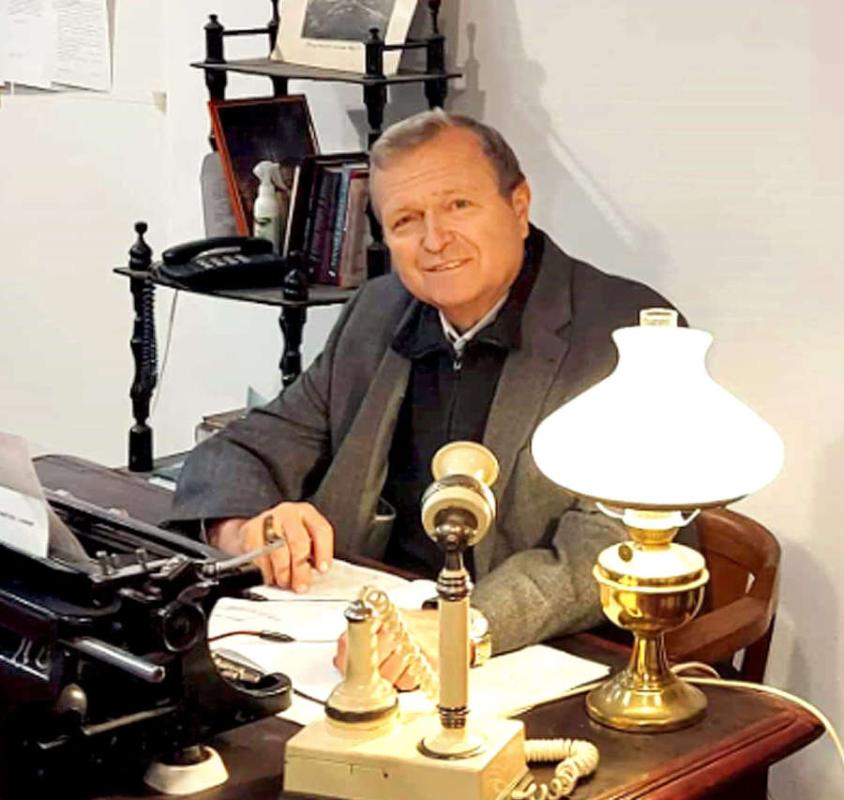
More precisely, not with KPI, but at KPI. We are talking about Viktor Vasylovych Lazarenko, who celebrated this honorable anniversary in September this year. Undoubtedly, many employees of Kyiv Polytechnic University are familiar with Viktor Vasylovych: some have collaborated with the Department of Technical Training Resources, which he headed for over 30 years (from 1992 to 2023), some have turned to him and the department staff for help, and some have visited room 161 of the first building, where the department is located, as if it were a museum of the early years of KPI. Incidentally, it really is a museum, where even tourists visiting the university are now taken, and it was created on the initiative and with the direct participation of Viktor Lazarenko.
...And it all started with a not very pleasant event: in the summer of 1975, Vitya Lazarenko, a graduate of the school in Novi Petrivtsi, did not get a passing score on the entrance exams to KPI. He had to find a job. There was no doubt about it — he decided to work right there. He found a place in the faculty he had dreamed of — the Faculty of Control Systems (as the current FIOT was then called), and the first entry in his new employment record book was the position of laboratory assistant in the Department of Technical Cybernetics. I started working at the computing center, equipped with domestic electronic computers MIR-1 and MIR-2, which, by the way, were created at the Institute of Cybernetics of the Academy of Sciences of Ukraine under the leadership of Academician V.M. Glushkov.
When asked why he chose KPI, Viktor Lazarenko replied: “Probably, it was the only thing that interested me at that time – some kind of technology, some kind of electricity. I was even shocked by electricity for the first time, probably when I was about three years old, when I was conducting an ‘experiment’ with my mother's hairpin and a socket.” Then there were other episodes. “And I realized that I needed to know something in order to achieve something,” says Viktor Vasylovych. Therefore, the choice was quite conscious. ...
After his first year of work, Viktor Lazarenko was drafted into the army—a path that millions of young men took in those days. So he clarifies that he did have a break in his KPI biography, although he did not forget about the institute. So after demobilization, he immediately went to work at the same department where he had worked before being drafted, took preparatory courses, applied, and now he had his dream student ID! He studied full-time for only a year, then switched to evening classes, because he felt like a mature person who had to earn money for himself and to help his family. He worked in the laboratory of technical means of automatic control systems as a technician, and later as a senior technician. After his third year, he was transferred to the position of engineer. During those years, he saw the sea for the first time at the institute's Mayak recreation center, where he worked during the summer. Incidentally, it was there that he met his future wife.
Shortly after completing his studies, some changes took place in Viktor Lazarenko's professional life: he was invited to work in the newly created educational television laboratory, immediately taking the position of deputy head of this department. In fact, it was a real institute educational television center. The center changed its name several times before becoming the Department of Technical Teaching Aids, which Viktor Vasilyevich headed in 1992. However, the tasks that the department performed and continues to perform were not limited to technical support for the educational process through video and audio recording, but also included ensuring the broadcast of certain content. Almost from the very beginning of its existence, on Viktor Lazarenko's initiative, the department's employees began to film the most significant events in the life of the institute. And there were many such events, because at that time the country was entering a period of radical changes in the entire system of socio-political life, which ultimately led to the collapse of the Soviet Union and Ukraine's independence. All this could not but affect the activities of the Kyiv Polytechnic Institute. One of the most memorable episodes of that time was the First Constituent Congress of the People's Movement of Ukraine, held in 1989 at the KPI Center for Culture and Arts. VTZN cameramen also filmed the event, but we will not be able to see those historical footage today. “The tapes were immediately confiscated by specially trained ‘competent authorities’ and, unfortunately, were never returned,” explains Viktor Vasylovych. Around the same time, the department's employees shot a video about the KPI at that time, “We Are Today,” the script for which was again written by Viktor Lazarenko.
He has a historical mindset and understands the importance of recording current events for those who will come to KPI tomorrow and the day after tomorrow, so his interest in the university's past seems quite logical. Over time, Viktor Lazarenko has become a true expert on this past and an enthusiast of its study. The visible result of this interest was room 161 of the first building, where the VTZN is located. Or rather, now it is a real museum room of the history of KPI – we mentioned it at the beginning of this article. It all started when he came across an album of pre-revolutionary photographs of the institute. Among the photographs, Viktor Vasylovych saw and recognized his department's room in one of them. It turns out that in the early years of KPI's existence, his accounting department was located there. "The accounting department is a room that was definitely visited by those people whose monuments now stand on the university grounds. They couldn't help but come here: some paid for their education, others were paid for their work and teaching," Viktor Lazarenko now tells students and schoolchildren who visit this room. "Of course, I mention the names of Paton, Korolyov, Sikorsky, and others, and I say: you have entered the place where these people used to be. And you have every chance to become no worse and no less famous than them. So, if you work hard, you will succeed." And to make everything as it used to be, after the renovation in 2019, the room was furnished as closely as possible to the old photographs. Everything — the doors, the barrier at the entrance, the furniture, and lighting fixtures, etc. — everything was found (sometimes even in old dumps) and restored, or purchased at their own expense and adapted to the interior by the department staff, who, so to speak, were inspired by their boss's idea and put a lot of their own work into creating this “living” museum corner. Some items were donated by university employees. That is why many things here are authentic, for example, a coat rack, a desk with ink accessories, a more than century-old armchair at the entrance, an antique wardrobe and a bureau from the early 20th century, and more. There are also modern replicas of antique items, which, however, do not stand out from the overall ensemble, but only complement it successfully.
It is interesting to talk to Viktor Lazarenko – you will always hear something interesting about the history of the university, look at familiar things in a new way, and get useful advice on work issues. The department's work has gained new momentum—it now also provides recording and online broadcasting of all thesis defenses and performs a number of other tasks. These tasks are also handled by Viktor Vasylovych, who continues to work at the VTZN as a lead engineer and, in his spare time, conducts tours of Room 161 and the historic Great Physics Auditorium, continuing to promote our KPI.