
Igor Sikorsky Kyiv Polytechnic Institute has long since ceased to be merely a space of lecture halls where knowledge is transferred from teacher to student. Today, the university is a living laboratory of ideas, where a new generation of specialists is being shaped at the intersection of science, engineering, and responsibility. So it makes sense that this is where the finals of the 5th All-Ukrainian Engineering Hackathon SmaRTF took place—an event that was not just another competition, but a true symbol of our times, in which technical thinking takes on strategic importance.
The anniversary SmaRTF brought together young, ambitious, and creative inventors from various faculties, but with a single motivation—to create solutions in the field of smart military electronics to strengthen the state’s resilience. This phrasing sounds restrained, almost dry, yet behind it lies a deep understanding of the reality in which the country lives. For the students who participated in this competition—tech-savvy individuals who care deeply about our country’s current needs—defense technologies are not an abstract field or a page from a textbook, but a challenge that must be met with knowledge, precision, and responsibility.
In general, SmaRTF is not just a story about competition for the sake of competition. It is a story about an engineer’s journey from idea to result. The three stages of the hackathon served as a test of intellectual maturity.
The first—presenting one’s own idea—required not only technical expertise but also the ability to think systematically: to explain why the development exists, what problem it solves, and why this particular solution is appropriate. This was the beginning of the journey, when not a schematic but a concept was born and presented.
The second stage—working with components within a budget of up to $800—shattered the illusion of unlimited possibilities. It is at this stage that engineering in real life ceases to be romantic and becomes practical. The hackathon’s limited budget forced us to seek compromises, optimize, cut out the unnecessary, and focus on the essentials. This is invaluable experience, because in practice, the financial conditions under which an engineer implements their projects are, more often than not, far from ideal.
The third and final stage—creating a functional prototype and presenting it to the jury—was the culmination. Because a prototype accepts no excuses and responds to no pretty words. It either works or it doesn’t. It is at this very moment that theoretical knowledge is put to the test of reality, and teams are tested on their ability to work together under the pressure of relentless deadlines.
The SMART MILITARY ELECTRONICS 4.0 theme covered five categories of engineering solutions—from defense systems to logistics technologies. The eight finalist teams that reached the final stage demonstrated different approaches but shared a common understanding: modern warfare is not just about technology, but about the speed of decision-making, data accuracy, and system efficiency.
The event gained particular significance through its organization at the Faculty of Radio Engineering of Igor Sikorsky Kyiv Polytechnic Institute in collaboration with Renesas Electronics Corporation. This partnership exemplifies how a university and a global technology company can collaborate not merely formally, but in substance. Students gain not only a platform for experimentation but also a sense of belonging to the global engineering ecosystem. The hackathon’s partners (including Minstrategprom, Atlon Avia, INFOZAHYST, NDA Recruitment, Protector and Force Company, Quantum Systems, Skyeton, and Skyfall) clearly demonstrate another important point: the state and industry are beginning to look more closely at the university as a source of solutions, not just a “talent factory.” This marks the beginning of a gradual but extremely important shift in thinking.
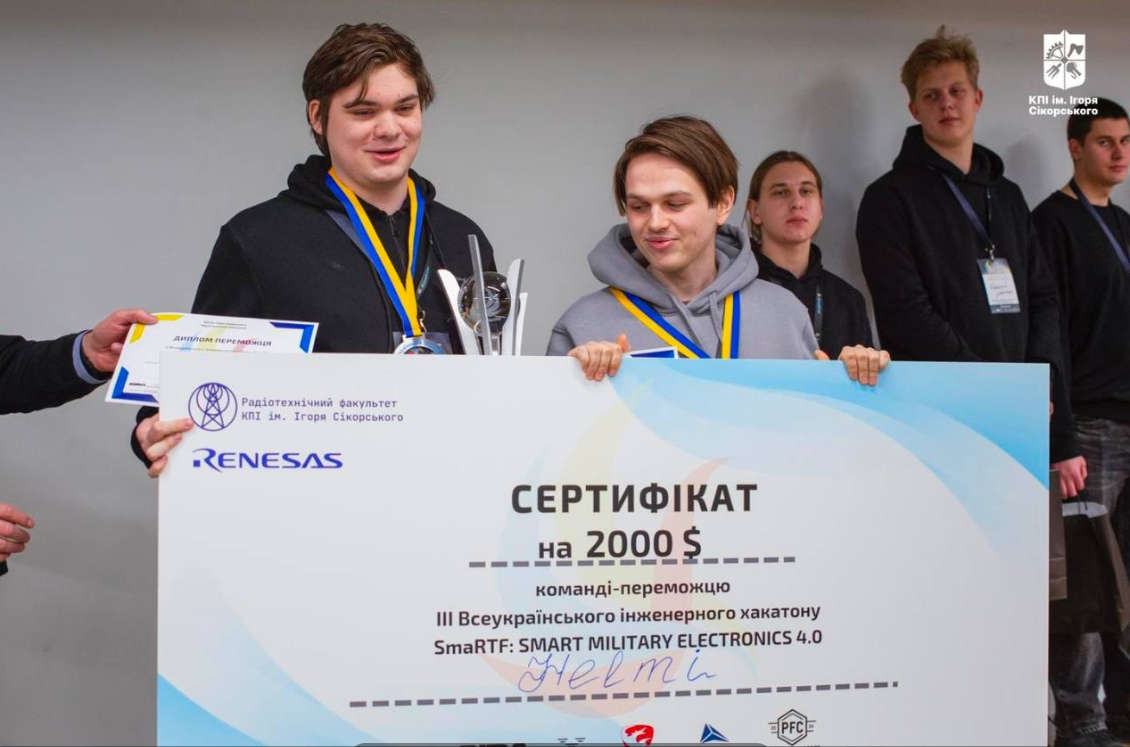
The grand finale of SmaRTF was the announcement of the winners. First place went to the HelMi team, composed of students from various departments at Igor Sikorsky Kyiv Polytechnic Institute—students from the Faculty of Software Systems and Applied Mathematics, the Institute of Nuclear and Thermal Power Engineering, and the Faculty of Radio Engineering. Their success is proof that interdisciplinarity is no longer just a buzzword but a real advantage. It is at the intersection of programming, electronics, and engineering thinking that next-level solutions are born.
Second and third places—the teams flysus and 3M—confirmed that the competition was fierce and the quality of the work was high.
For many participants, this hackathon was their first experience publicly presenting their own development to industry experts. And perhaps this very experience will serve as a starting point for future startups or scientific research.
So SmaRTF is not just about victories and prizes. It is about shaping a new type of engineer: one who thinks critically, works in a team, understands the context, and is aware of the consequences of their work. In an environment where the stability of the state increasingly depends on technology, such events take on strategic importance.
Within the walls of Igor Sikorsky KPI, it is not just professional competence that is being shaped today, but engineering responsibility. And surely, it is precisely from such hackathons that the future begins, in which smart technologies become not just a slogan, but a real tool for the protection and development of the country.
lockquote class="4u">The anniversary hackathon traditionally brought together young, ambitious, and creative inventors, who this year designed solutions in the field of smart military electronics to strengthen the country's resilience.
Here is a short video about the event:
The teams went through three stages:
🔹presentation of their ideas;
🔸working with components within a budget of up to $800 per team;
🔹creation of a functional prototype and its presentation to the jury.
SMART MILITARY ELECTRONICS 4.0 is:
5 categories of engineering solutions — from defense to logistics;
8 finalist teams in the final stage.
📌 The hackathon was held at the Radio Engineering Faculty of KPI in collaboration with Renesas Electronics Corporation.
🤝 Event partners:
Ministry of Strategic Industries
Atlon Avia
INFOZAHYST
NDA Recruitment
Protector and Force Company
Quantum Systems
Skyeton
Skyfall
🏆 Congratulations to the KPI winners of SmaRTF!
🥇 HelMi — $2,000 and prizes from partners
Oleksandr Botvinov, student of the Faculty of Program Systems and Applied Mathematics (FPSAM)