

Kyiv is home to several historic buildings with fascinating stories and unique architecture. In addition to their distinctive exterior details, these buildings are often shrouded in mystery and surrounded by various legends. One striking example is the building at 23 Hoholivska Street. This mansion is also connected to at least two notable figures associated with Igor Sikorsky Kyiv Polytechnic Institute: an architect and a world-renowned scientist.
The History Without Myths. The early twentieth century saw a remarkable construction boom in Kyiv. Apartment buildings sprang up one after another, each more impressive than the last, as landlords did their best to attract tenants. Thus, in 1909, an extravagant greenish building appeared in the Soldatska Slobidka neighbourhood, commissioned by Major General Ferdinand Yahymovskyi. Built in the Art Nouveau style with Gothic elements, its façade resembled a theatrical set: it was asymmetrical, with windows and balconies of different sizes and designs. A small tower topped with a spire crowned the right-hand corner. The building had four storeys facing the street and five on the courtyard side.
This architectural gem was designed by architect and engineer Volodymyr Bezsmertnyi, who headed the Kyiv Provincial Construction Department from 1893 to 1919 and served as chairman of the Kyiv branch of the Society of Civil Engineers for 12 years. From 1919 to 1921, he taught at a construction technical school in Odesa, and in 1922 he also taught at Kyiv Polytechnic Institute. From 1926, Bezsmertnyi served as a technical inspector and municipal engineer in Kyiv, and from 1922 to 1931, he was the city’s chief architect.
History with Myths. Indeed, like its contemporary on Bankova Street, the “House with Chimaeras,” the Yahymovskyi’s House inspires either criticism or admiration, but leaves no one indifferent. Its bizarre façade seems to have a life of its own, concealing the secrets of the past behind its walls while silently observing the bustle of the present. On the ground floor, beneath a huge semicircular window framed by geranium leaves, sits a pair of green-eyed cats. They have become the symbol of the building and given it its unofficial name: the “House with Cats.” According to local lore, the cats act as guardians, protecting the house from the evil eye and preserving peace and prosperity. Among the decorative details, one can also spot male mascarons, each with a distinct facial expression — another source of inspiration for urban legends.
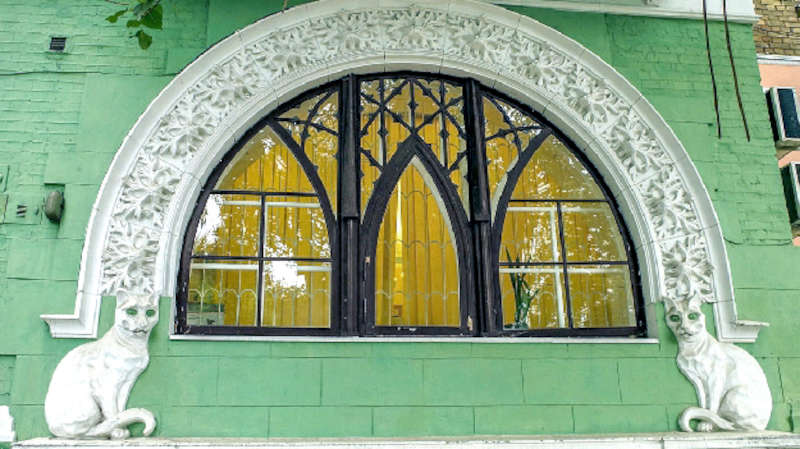
Equally remarkable are the owl figures adorning the entrance. Owls are believed to symbolize wisdom. Their watchful eyes seem to peer through time, embodying reason and tranquillity. At the very top of this architectural composition stands a fantastic creature — a figure that might represent a demon or devil, or perhaps Koschei the Deathless (remember the architect’s surname?) — adding a mystical touch to the building. Could it be that the cats are there to protect the house from this creature’s evil intentions? Hence yet another name for the building: “Koschei’s Castle.”
Ukrainian filmmakers have also taken an interest in this unusual structure. It featured in two films: Grandpa on the Left (Did livogo kraĭnogo), directed by Leonid Osyka and starring Mykola Yakovchenko in 1973, and A Walk with Vrubel (Prohulianky z Vrubelem), released in 1989.
Just Myths. As is well known, in medieval Europe, cats were often associated with evil forces, as they were commonly believed to accompany witches. Witches themselves were also said to be able to transform into cats. According to ancient beliefs, every witch had a familiar — usually a spirit or an animal that assisted her. Cats and owls were among the most common familiars. Some dynasties, however, featured these four-legged creatures on their coats of arms as symbols of independence, since, as the saying goes, a cat walks wherever it pleases. Cats are also believed to be companions to psychics and symbols of intuition, capable of travelling between worlds and venturing into the afterlife.
Naturally, sightseers often stop by the house. The stories they hear are limited only by the storyteller’s imagination. Listen if you feel like it. According to one legend, a girl of extraordinary beauty once lived in this house. She was blonde, with green eyes. Fearing that she might be abducted, her parents would not let her go out alone. To keep their beautiful daughter from wasting away indoors, they added a tower from which she could admire the world. One day, however, Baba Yaga caught sight of her and told Koschei, who immediately decided he wanted the beauty for himself. He promised to reward the gossip, but… forgot.

When the lecherous villain flew off to claim the girl, the offended Baba Yaga turned her into a white kitten. And so Koschei was left empty-handed, while the kitten went to live with her parents, who were grieving over their missing daughter, unaware that the white cat was their child. To ease their sorrow, they travelled widely, taking their purring companion along on every journey. But one day, in a distant land, the little white cat disappeared. Her inconsolable owners searched for her for a long time. When they returned home, they mourned her deeply, until eventually they got another cat that looked just like the one they had lost.
Had the story ended there, no one would have remembered it. But something strange happened. A few months later, the first cat returned home, leaving the owners with two fluffy companions. The cats became friends and hunted birds together in Pavlivskyi Square. On one occasion, they even saved their owners from burglars who had broken into the flat, knowing that no one was home. The two feline defenders caused an incredible commotion: spoons flew to the floor, forks clattered, and dishes crashed. Faced with such chaos, the hapless thieves naturally fled. When the two feline friends eventually passed away, their owners placed statues of their beloved pets beside the window, where they seem to greet visitors as they approach the house.
Moreover, a new story about the building has recently been circulating around Kyiv. If you connect on a map the locations of the “House with Chimaeras,” the “House with Cats,” and the “House with a Gargoyle” on Velyka Zhytomyrska Street, you get a triangle with Saint Sophia’s Cathedral lying almost at its centre. According to the legend, the cathedral protects the city from all kinds of evil spirits.
Events of the Distant Past
Among the best-known residents of the building on Hoholivska Street was Stepan Tymoshenko, a renowned mechanical engineer, professor, and academician of the Ukrainian Academy of Sciences (1918). He served as Dean of the Mechanical and Civil Engineering Faculties at Igor Sikorsky Kyiv Polytechnic Institute (1909–1911), Head of the Department of Strength of Materials (1906–1908), and Professor in the same department (1906–1911, 1918–1920). He was an honorary member of academies of sciences and scholarly societies, received honorary doctorates from leading universities around the world, and was awarded prestigious medals named in honour of distinguished figures for his contributions to science and engineering.
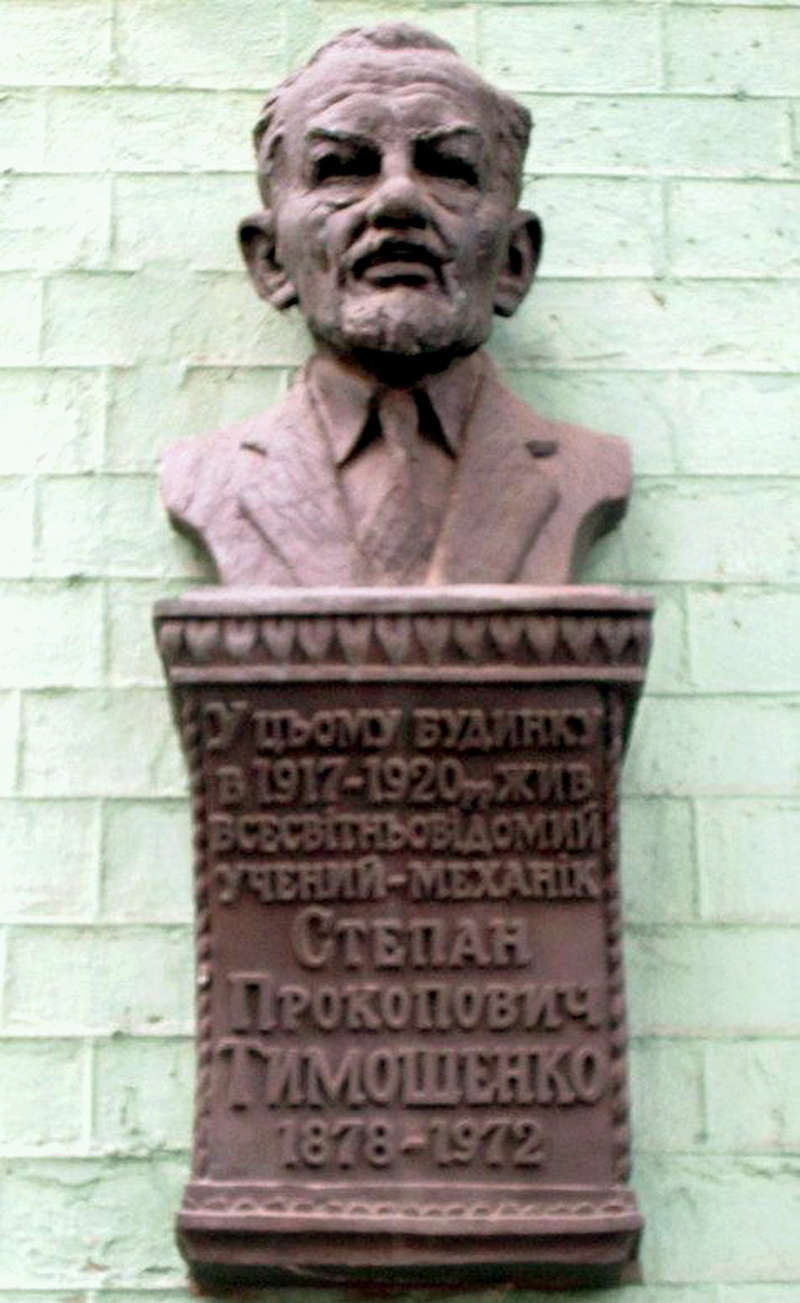 In the photo: bust of Stepan Tymoshenko
Recent Events
A memorial plaque on the building serves as a reminder of events from a century ago. Until recently, the building also featured a bronze bust of the scientist, created by sculptor M. Savelyev and architect V. Prykhodko. It was installed in 1995, but, unfortunately, did not remain there for long: in 2016, it was stolen. As they dismantled the sculpture, the thieves had no idea that they were putting into practice the laws of mechanics described by the very scientist whose bust they were stealing (much like those who made off with the massive memorial plaques from the State Polytechnic Museum. And no one made a fuss about that, either.) Now, all that remains on the wall is a modest plaque, of little interest to either collectors or scrap-metal hunters. It would be worth adding a QR code, too; sometimes we know more about cats than about famous people born in Ukraine.
“While the world knows him as the ‘father of American applied mechanics,’ we honour him as the scientist who laid the scientific foundations for the construction of Ukrainian bridges, aircraft, and industrial giants. The National Academy of Sciences of Ukraine has already begun preparations to mark the 150th anniversary of the birth of Stepan Prokopovych Tymoshenko, which falls in December 2028. This will provide another opportunity to highlight the scientist’s contribution to the development of global science and the role of the Ukrainian scientific school,” the Academy’s website states.
From the Scientist’s Memoirs
And here, once again, a cat makes an appearance. Recalling the hunger and cold of 1919, when power in the city changed hands so many times that no one could keep count, S. Tymoshenko writes:
“At the Polytechnic Institute, the lecturers elected a special committee to procure food. It was headed by the energetic Professor Yevhen O. Paton. He managed to obtain a considerable quantity of wheat, and I received a sack of grain. The wheat turned out to be damp, so it had to be dried on the balcony. To protect it from birds, we put a cat there.

Later, we had another stroke of luck. Yevhen K. Garf, a former colleague of mine, came to see me. He had learned that a wartime depot was being liquidated and that a rare commodity such as sugar was being sold there without restrictions. With Garf’s help, I bought and carried home several poods of granulated sugar. This immediately improved our situation: we could not only drink tea with sugar but also barter it for other food at the market.
By the autumn of 1919, the activities of the Academy, which had been deprived of funding, were coming to an end, while classes at the Polytechnic Institute had not even begun.”