
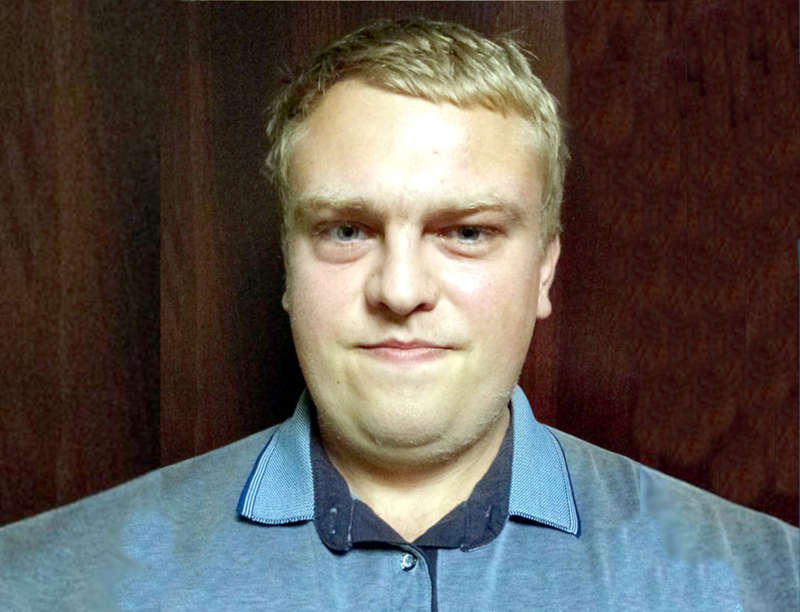
At the end of last year, the Ministry of Education and Science issued an order on the awarding of the President of Ukraine’s academic scholarships to graduate students for the 2025/2026 academic year. These scholarships will be awarded to candidates with outstanding scientific or academic achievements as an incentive for their work and motivation to achieve high results. Among the recipients is Andriy Makarchuk, an assistant professor in the Department of Software Engineering in Energy at the Institute of IATE.
Let’s get to know him. Andriy, first and foremost, speaks with respect and pride about the university: “I chose KPI for my graduate studies because this institution is Ukraine’s leading technical university. At the beginning of my second year of my bachelor’s program, I became actively interested in methods of function approximation; however, as I approached my master’s studies and began to achieve my first scientific results in this field, simply deriving formulas was no longer enough: I wanted to apply my findings in engineering, and KPI provides excellent opportunities for this.”
Currently, in addition to function approximation methods, the young researcher is also engaged in machine learning, specifically its application to ensure the functional stability of information and multi-machine computing systems. He has already achieved certain results. “For example,” the researcher explains, “by using machine learning models as approximation methods, I managed to develop an algorithm that allows one to find the optimal combination of machines for forming a network in terms of functional stability, even with a limited budget.” Regarding further scientific research, the researcher believes there is potential to improve existing methods for studying the functional stability of multi-machine systems by combining insights from several research areas: Fourier analysis, machine learning, and approximation theory. In the future, the researcher plans to develop a comprehensive methodology that, through such integration, would significantly optimize the design of information (and not only information) systems.
During the conversation, Andriy repeatedly returns to his alma mater, emphasizing that it has long fostered a creative environment for the scientific and professional growth of young researchers. “I would like to give special mention to the Department of Software Engineering in Energy, and especially to my research advisor, Oleg Volodymyrovych Barabash, and the department head, Oleksandr Vasylovych Koval, for their comprehensive support in conducting research and for the opportunities to contribute to the education of the younger generation,” the lecturer emphasized.
In conclusion, A. Makarchuk noted: “I would like to add that I am always open to communication with both students and other researchers and educators. I believe that comprehensive communication always yields the best results and will be beneficial to each of us, and quite possibly even in unexpected ways.”
So let’s wish this young scholar a supportive professional community, creative success, and inspired students.