
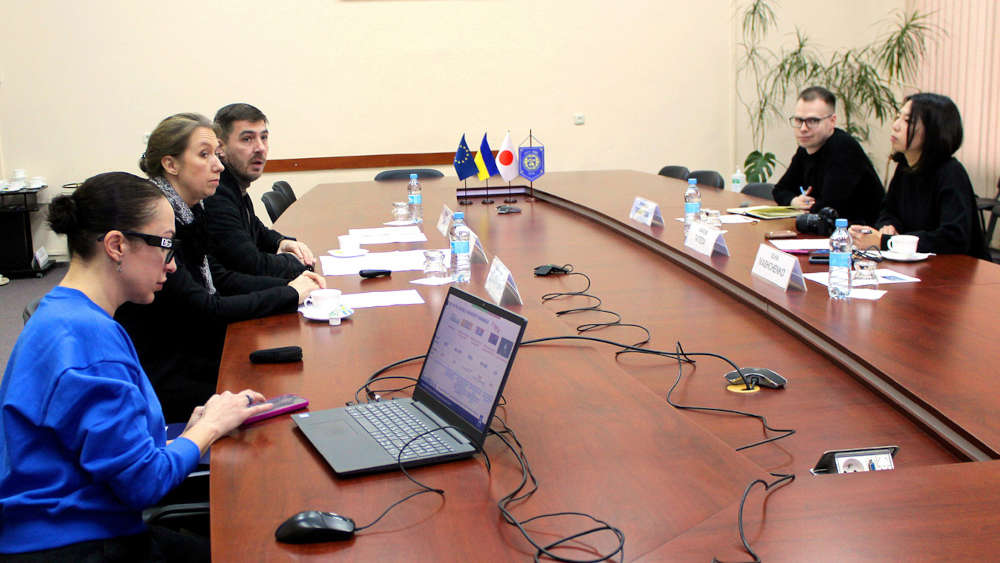
Andriy Shysholin, Vice Rector for International Relations at Igor Sikorsky Kyiv Polytechnic Institute (KPI); Oksana Vovk, Director of the Educational and Scientific Institute of Energy Conservation and Energy Management at KPI; and Kateryna Lugovska, Director of the Ukrainian-Japanese Center at KPI, met on December 16 with Mykhailo Turyanytsia, a communications specialist at the United Nations Office for Project Services (UNOPS), Mykhailo Turyanytsia, and a journalist from the Kyodo News Agency, Narumi Tateda (Japan).
Following a presentation on the university given to the guests by Andrii Shysholin, the main topic of discussion was the implementation of an educational program on humanitarian demining at the Educational and Scientific Institute of Energy Conservation and Energy Management. Oksana Vovk provided a detailed account of this program and its features. And she wasn’t alone—students from the Institute of Energy Conservation and Energy Management, who are pursuing higher education in this field, spoke online about their studies and the reasons for choosing this particular specialty. The conversation with the students, by the way, sparked keen interest among the guests: they asked the Polytechnic students about their reasons for choosing this path; how their parents reacted to it; what career prospects they see in this field, and so on. There is no point in recounting the young participants’ answers in detail, as the underlying theme of everything the students said was patriotic reasoning and the acknowledgment of the necessity of this profession for our country. It is worth noting in passing that during the conversation, our students demonstrated a very good command of the English language.
"…These are truly motivated young people. This is a new generation of engineers who will possess those unique competencies that will allow them, first, to be successful in their future careers, and second, to carry out critical tasks—both in land remediation and in the application of environmental protection technologies. And the fact that, moreover, virtually all of them have a very good command of foreign languages—not just one—gives us an additional bonus: the opportunity to represent Ukraine’s youth abroad, because young people always listen better to other young people,” commented Oksana Vovk on this dialogue.
However, the discussion also touched on issues regarding the material support for the institute’s new educational program. According to the director of the NEE, the UN Office for Project Services has already provided KPI with some equipment samples free of charge. “We use it to train our students in educational programs on humanitarian demining,” explained Oksana Vovk, “as well as in our scientific and research work in the field of mine safety.”
"The role of our Office is to provide targeted assistance within the framework of clearly defined projects for key stakeholders in Ukraine to promote its socioeconomic development, as this is, in fact, one of the UN’s missions. “So, with funding from the European Union, we are purchasing and transferring equipment that will be used for effective student instruction, training, and honing their skills,” Mykhailo Turyanytsia told “KP.” “The total cost of the equipment we plan to transfer is approximately one and a half million hryvnias.” Moreover, according to him, this program may potentially be extended, especially since international partners view KPI as a leading educational and scientific institution and training center in the field of mine action and humanitarian demining.
The participation of a representative from one of Japan’s leading news agencies in this meeting was significant. Oksana Vovk also noted this: “It’s very good that the Japanese side is showing interest specifically in this area at KPI… This is another opportunity to tell the world what is actually happening in Ukraine.” And, we might add, about the challenges our country faces, because the scale of demining work across entire regions of our country is simply enormous; therefore, it must be carried out as efficiently as possible and with the maximum use of the most advanced technological solutions. And the specialists that KPI has recently been training are not so much deminers who will work in the field, but first and foremost those who will ensure the effectiveness of demining, make this system more productive, and develop innovative tools, methodologies, and more for it.
Of course, the guests also visited the Igor Sikorsky Kyiv Polytechnic Institute Ukrainian-Japanese Center at the university’s Scientific and Technical Library. Kateryna Lugovska provided a detailed account of its activities, programs, and events. However, even the Center’s facilities themselves—its exhibition hall, the Ukrainian-Japanese library (undoubtedly the best in Ukraine!), the Stone Garden, the tea room, and the auditoriums, or rather, the classrooms for Japanese language lessons and traditional logic games like shogi and go—spoke for themselves.
The visit concluded with a tour of the laboratories and equipment at the Institute of Electrical Engineering, which is used to train bachelor’s and master’s students in the field of mine action and humanitarian demining, including equipment the institute received as part of an assistance program implemented by UNOPS.
For reference:The United Nations Office for Project Services (UNOPS) is a United Nations agency that provides services in the areas of infrastructure development, procurement, and project management. It has been operating in Ukraine since 2016. Mine action is among the areas of UNOPS’s work in our country.
Kyodo News is one of Japan’s largest and most influential independent news agencies. It serves as a key news source for Japanese and international media on events in Japan, Asia, and around the world. It actively covers events in Ukraine.