

“Sun and Sky, Sea and Wind” is the title of an exhibition of works by Mykola Hlushchenko, which has opened in the main hall of the Borys Paton State Polytechnic Museum at the university. The exhibition marks the 125th anniversary of the artist’s birth. This is a remarkable event: works by artists of such calibre have never before been displayed in the halls of Igor Sikorsky Kyiv Polytechnic Institute.
“The purpose of our exhibition has two main aspects. The first, of course, is to mark the anniversary and pay tribute to such a unique Ukrainian artist. The second is to introduce a broad audience of lecturers and students of Igor Sikorsky Kyiv Polytechnic Institute to his work and the fascinating story of his life,” said Olena Zikieieva, Head of the Directorate of Art Exhibitions of Ukraine, at the exhibition opening on 5 November.
Until 30 November, members of the Kyiv Polytechnic community and all art lovers have the opportunity to see for themselves the works of this outstanding Ukrainian artist, whose name is known around the world and whose paintings are held in numerous private collections and leading museums across many countries.
Hlushchenko: The Artist Whose Name Even Those Unfamiliar with Art Have Heard
The name of Mykola Petrovych Hlushchenko is familiar not only to art enthusiasts. Many people have heard of him as a successful intelligence agent who, under the codename “Yarema,” carried out several successful operations abroad. He lived there from 1919 to 1936 and continued to return for exhibitions – both solo and group – almost until the end of his life.
Some may also recall that in 1940, on returning from a business trip to Berlin, he brought back an album of Hitler’s watercolours, which he had received as a gift from this would-be “artist-architect.”
Fewer people know that Hlushchenko was among the first intelligence agents to warn the Soviet leadership that Germany was preparing a major war against the “Land of the Soviets.” Several documentaries, dozens of articles and even a novel have been devoted to this aspect of the renowned painter’s life.
Yet Mykola Hlushchenko himself preferred not to speak about these chapters of his life – they had cost him far too much. For by vocation, talent and temperament, he was an artist through and through, down to the very last fibre of his being.
And so the true and most valuable legacy he left Ukraine is, above all, his paintings, studies and graphic works. Just 28 of them are on display at the State Polytechnic Museum. These works come from the collection of the Directorate of Art Exhibitions of Ukraine. They represent only a tiny fraction of Hlushchenko’s vast artistic output. He worked quickly and prolifically, thanks to his artistic temperament, distinctive style and thorough training, which he received in Berlin and then further refined on his own in Paris. Even when travelling abroad as an organiser of exhibitions of Ukrainian or Soviet art (the term “curator” was not yet in use in our country during his lifetime), he had countless practical matters to attend to, yet still returned with dozens of sketches and studies.
Landscapes, Still Lifes and “Nudes”
The exhibition’s title perfectly captures the essence of the works on display. It features landscapes (Hlushchenko, incidentally, is widely regarded as an unsurpassed master of this genre), two still lifes and even several works in the “nude” genre, depicting the unclothed human figure. Every single one is painted in the free, uninhibited style characteristic of this artist, particularly during the later period of his career.
It is known that he began by creating paintings that creatively reinterpreted the legacy of the Northern Renaissance, with its layered painting techniques and emphasis on clearly defined contours. In his works, which reflect a distinctly Ukrainian outlook, he organically combined elements of French Impressionism, Post-Impressionism and even Fauvism, absorbing these influences during his years in Europe. No wonder his fellow artists called him “the Frenchman.”
It may seem paradoxical: such free-spirited painting in a country where no artist could consider themselves entirely free from ideology, party directives or the obligation to fulfil a “social commission.” However, it should be remembered that Hlushchenko had earned the right to artistic freedom through his international recognition and fame. He had also established friendships with prominent figures in art and culture whose portraits he painted during his years abroad, including Henri Barbusse, Romain Rolland and members of the French left-wing intelligentsia. They would hardly have understood it if the Soviet Union had launched a campaign against an artist recognised around the world.
When discussing Hlushchenko’s work, one sometimes comes across the claim that it is distinguished by veritable “explosions of colour.” Personally, I find the word “explosions” rather ill-chosen in this context, especially for us – people whose lives have been marked by war, who hear explosions every day and witness their aftermath. Hlushchenko’s canvases are not about “explosions” but about a true celebration of colour, a hymn to nature and its beauty in all its forms, and an expression of wonder at the diversity of life on Earth.
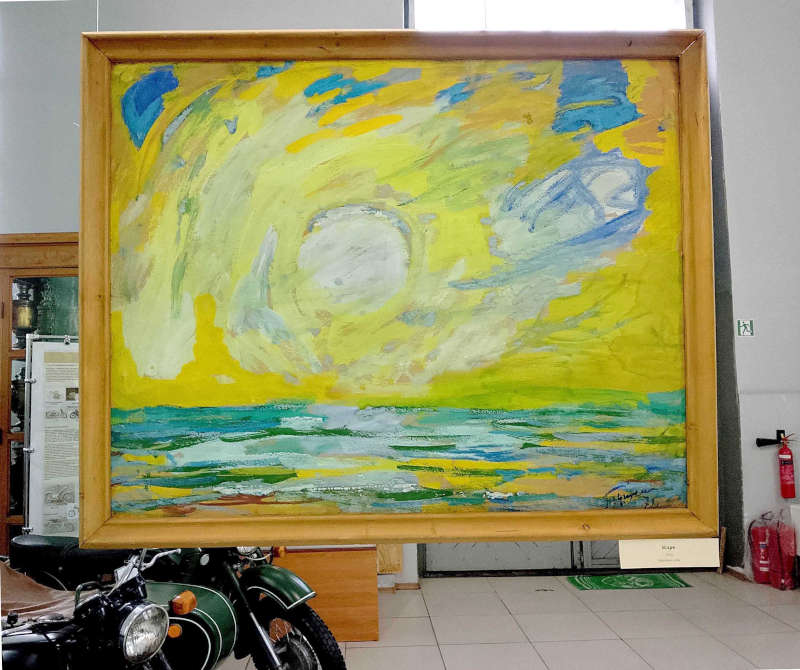
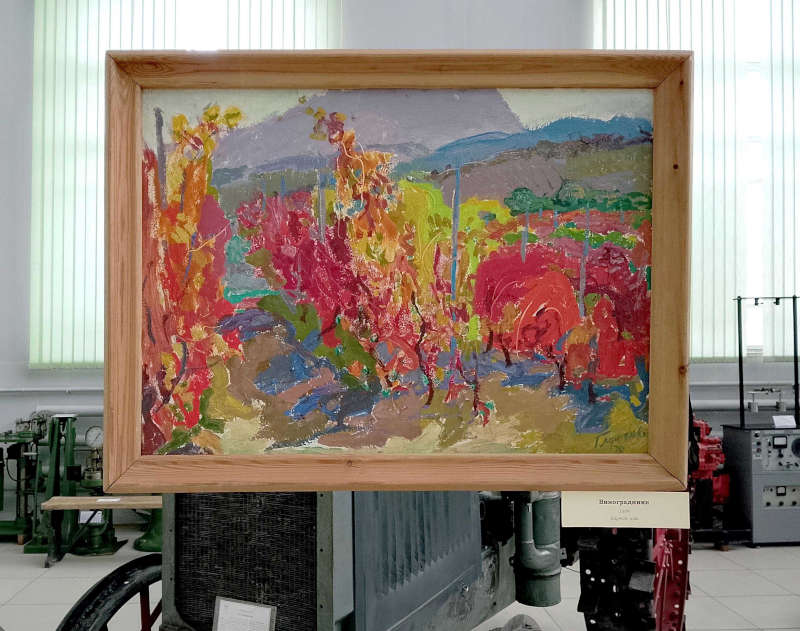
And yes, his paintings sometimes feature extraordinarily powerful bursts of colour, as in “Vineyards,” one of the works on display. Such accents form the very compositional heart of many of his paintings and studies. Or take the painting on cardboard entitled “The Sea,” where the viewer’s attention is first drawn to the triumphant radiance of an enormous sun above the restless sea.
Then there is a large, classical still life: bunches of lilac against a seascape visible through open balcony doors. Filled with the light of spring and seemingly steeped in iodine-rich sea air, this painting radiates the joy of being alive and a sense of harmony. It deserves to be studied closely, as, indeed, do all of Hlushchenko’s works. Only then will viewers notice just how many different shades white can have: the lilac blossoms are quite unlike the gleaming porcelain vase or the wings of a seagull against the blue expanse. And the tablecloth has an entirely different hue, having absorbed countless reflections from the ochre floor, green leaves, blue sky and warm-toned walls.
Hlushchenko’s works in the highly challenging genre of the nude are equally rich in colour. His nude models are never isolated from their surroundings: they are always part of an environment filled with patterned carpets, flowers in vases and the light coming through the windows. Taken as a whole, these works on cardboard are true hymns to the beauty of young women and women in their full bloom.
There is, however, one painting in the exhibition with the concise title “GRES,” apparently executed in the style of an industrial landscape. A reminder: GRES is a thermal power station, and this now largely forgotten Soviet-era abbreviation stands for the Russian phrase gosudarstvennaya rayonnaya elektrostantsiya (state district power station). Yet here, too, the artist seems less interested in portraying the pace of socialist development than in the rhythmic interplay of horizontal lines – the reflective surface of the water and the station buildings – and the verticals formed by its chimneys. All of this unfolds in a world of colour that shifts from warm tones in the foreground to cooler ones towards the distant shore. Below, the rippling surface of what may be a river or a reservoir lies beneath an immense, restless sky, illuminated by multicoloured reflections from the power station. Its sun disc is somewhat muted, with only a narrow strip of its upper orange edge shining brightly, peeking through the haze of clouds and smoke. This small patch of sunlight, incidentally, masterfully balances the entire composition: remove it, and the landscape takes on an unsettled, almost anxious mood. It is a vivid illustration of how the art of composition rests not only on artistic intuition or inspiration but also on precise calculation…
In fact, every work in the exhibition deserves individual attention. But there are 28 of them, as we have already mentioned, and newspaper space is limited. Besides, paintings cannot be adequately described in words – it is far better to see them with your own eyes. And even if some of the works may seem a little too uninhibited to certain viewers, there is no need to rush to judgement: what they offer is not a naturalistic inventory of details but a generalised vision of the world and an admiration for its diversity.
Go to Exhibition Openings!
The first day of the exhibition once again showed just how much fascinating insight one can gain at exhibition openings. Alongside museum professionals, artists and students from art schools, the opening of Mykola Hlushchenko’s exhibition also attracted people who, during their studies in the 1970s, had the good fortune to know the renowned master personally and even study under him.
Artist and teacher Eduard Mezhul recalled Hlushchenko’s extraordinary work ethic, which was considered almost exemplary among his fellow artists. Iryna Kudina, a renowned artist, the master’s student and one of his favourite models, shared memories of the unforgettable lessons in artistic skill she received from Mykola Petrovych and the happy hours they spent working together in his studio.
Their accounts really deserve to be reproduced here in full, but once again, we are limited by the space available in the newspaper. So, friends, go to exhibition openings – and you will hear all these stories for yourselves!
The Exhibition Hall
We have already written about the distinctive features of the university museum’s large hall, where the exhibition is currently on display. The space was once occupied by teaching and mechanical workshops, later became the workshop of the Department of Metal Technology, and even served as a machine shop for the Ivan Lepse Plant. Its spacious interior benefits from excellent natural light streaming in through the side windows and the partially glazed roof. The elegant riveted trusses, together with numerous examples of technology from different periods, create a unique atmosphere when combined with works of art – a genuine dialogue between humanity’s material and spiritual heritage.
“This is not the first exhibition we have organised in this hall. It is a challenging and fascinating space, and one that I personally find deeply inspiring. Whenever I enter it, I am reminded of my favourite museum, the Musée d’Orsay in Paris, which was opened in a former railway station,” says Olena Zikieieva. “Here, we achieve an unexpected effect: works of art, especially fine art, displayed alongside machinery designed for peaceful purposes, give rise to new and unconventional ideas, new meanings and new interpretations. In this respect, our cooperation with the museum of Igor Sikorsky Kyiv Polytechnic Institute is very interesting and, I believe, holds great promise.”
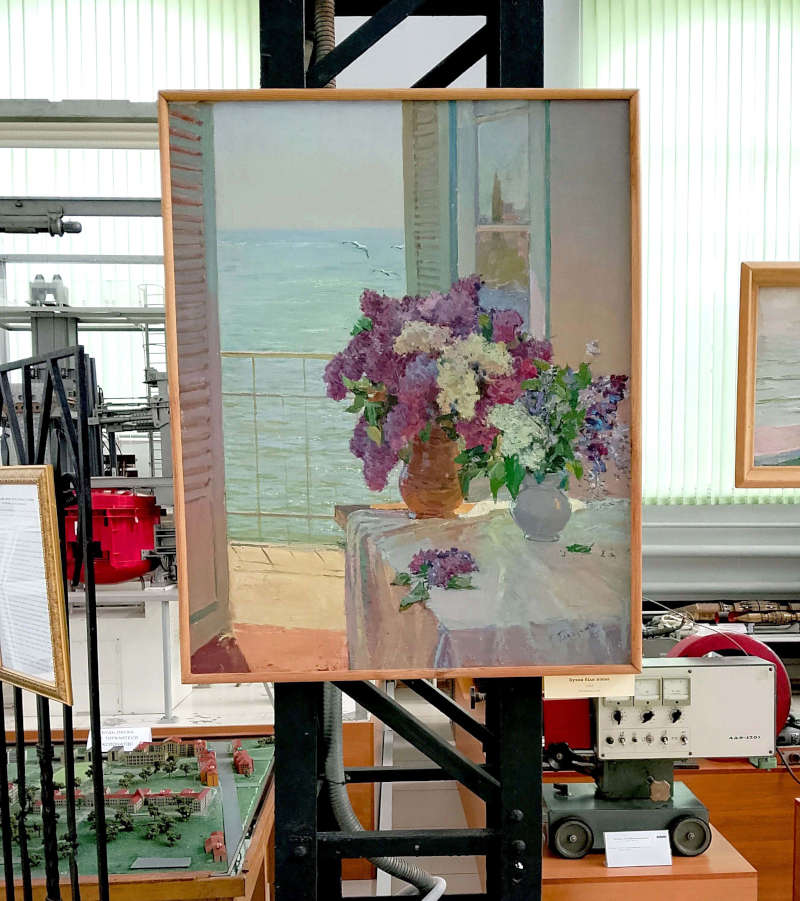
Incidentally, as Olha Zaichenko, Head of the Department of Research and Educational Activities at the State Polytechnic Museum, explained, during preparations for the exhibition the organisers initially had doubts about whether the paintings should be mounted on the black trusses. In the end, they decided to make use of these steel supports as well – and achieved a wonderful effect by bringing together what might seem incompatible: static engineering structures and works of art brimming with movement and colour.
It would seem, then, that this museum space has every chance of becoming a popular exhibition venue in Kyiv in the not-too-distant future.