

In mountaineering, a “Snow Leopard” is an honorary title that has been awarded in the USSR since the mid-1960s for ascending the country's highest peaks—the seven-thousanders. Without oxygen tanks, without porters, with cumbersome heavy gear, in felt boots and self-sewn clothing, enthusiasts conquered the icy kilometers of mountain slopes. It was only in the 1990s that lightweight and reliable equipment and innovative materials appeared. Among the recipients of the “Conqueror of the Highest Mountains” badge is a constellation of Kyiv Polytechnic graduates. Let’s name them.
Natalia Oleksandrivna Korobova, class of 1973 – mountaineer, “Snow Leopard” (1988). Winner of the individual climb (1978), silver (1976) and bronze (1975, 1978) medalist in the pairs competition at the Winter Rock Climbing Championships. She has completed 12 high-altitude climbs of the highest difficulty. The thirteenth woman to receive the “Conqueror of the Highest Mountains” badge. She worked as an instructor at the ‘Globus’ Touring Club and trained more than one generation of rock climbers.
Vladimir Fedorovich Stadnik, class of 1963, “Snow Leopard” since 1988.
Viktor Mykolayovych Olifirov, class of 1979, “Snow Leopard” since 1989.
Yuriy Volodymyrovych Cherevko, class of 1982, “Snow Leopard” since 2010.
Volodymyr Hryhorovych Lanko, class of 1986, “Snow Leopard” since 2021.
Pavlo Mykolayovych Kyrychok, class of 1995, “Snow Leopard” since 2011.
Oleksandr Andriyovych Verba, class of 1974, currently an associate professor in the Department of Computer Science—mountaineer, Master of Sports (1977), “Snow Leopard” (1988), Candidate of Technical Sciences (1985). Three-time USSR champion (1980, 1983, 1984), eight-time Ukrainian SSR champion (1975–77, 1979, 1982–84). He has completed over 100 ascents, including 10 first ascents of routes of the highest difficulty category, 2 first ascents of then-unnamed peaks in the Pamir and Tien Shan ranges (now Boychenko and Vernadsky Peaks), and 2 ascents carrying the Ukrainian national flag:
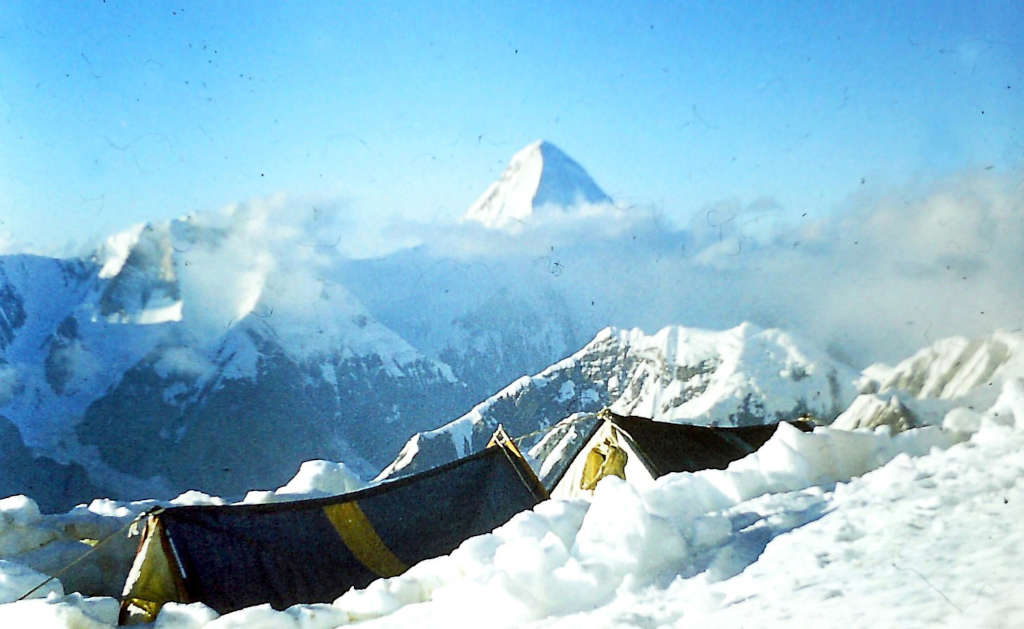 In the photo: Camp at an altitude of 6400 m.
Mount Olympus (Greece, 1992) and Mount Fuji (Japan, 1994). Head and coach of the Ukrainian SSR national team, which took first place in the USSR championships in 1983 and 1984. Chairman of the Presidium (1972–1974), Executive Secretary (1975–1981), and Head Coach (1982–1986) of the mountaineering section of the Ukrainian Council of the Voluntary Sports Society “Burevisnyk.” Member of the Presidium (since 1989) and Vice President (1995–1998) of the Ukrainian Mountaineering and Rock Climbing Federation.
Oleksandr Andriyovych enjoys meeting with members of the university hiking club, sharing his memories and experiences gained in the mountains. Below are excerpts from his stories.
On the “Snow Leopard” standards. There are five qualifying peaks to earn the title: the highest point of Tajikistan and the Pamir Mountains, Ismain Samoni Peak (Communism Peak) – 7,495 m; Ozodi Peak (Evgenia Korzhenevskaya Peak)—7,105 m (completed two ascents); the highest point in Kyrgyzstan and the most dangerous for climbing, Zhenish Chokusu Peak (Victory Peak)—7,439 m (one and a half ascents); Khan Tengri Peak – 7,010 m (two ascents); Abu Ali ibn Sina Peak (Lenin Peak) – 7,134 m (three ascents). Regarding the one-and-a-half ascent of Victory Peak: the route required exceptional physical fitness and teamwork; we were just a few hundred meters from the summit, but weather conditions forced us to turn back. It is said that until the 2000s, no one had ever been evacuated alive from there. A jagged ridge with slopes on both sides plunging up to 4,000 m, unstable snowpack, avalanches, very short weather windows, low temperatures, and hurricane-force winds left no chance of survival.
I joined the climbing group as a student. It began, as it does for all Polytechnic students, with rock climbing in Deneshy. There we learned the basics, honed our skills, prepared for climbs, and competed against teams from other clubs—“Avangard,” “Spartak”—mostly in the winter. We also went to the cliffs of the Sudak Fortress and other peaks in Crimea. We trained at mountaineering camps, particularly in the Caucasus and the Pamirs. I began climbing high mountains in 1969. Mountaineering helped me focus and gather my thoughts, but it was difficult to find time for trips (they wouldn’t let me take time off work. – Author)—for high-altitude training, climbs, and competitions with athletes from other republics. But the mountains wouldn’t let him go—because it’s so captivating, because it’s more than just the heights—it’s a challenge to oneself, a way to find inner harmony and feel freedom.
In sports, I’ve amassed a “collection” of honors and awards: the “Mountaineer of the USSR” badge—for my first ascent, then for my ranks, followed by Master of Sports, a rescue squad identification badge, a member of the Ukrainian SSR national team, a national sports judge, an anniversary badge for the 50th anniversary of the Ukrainian Mountaineering Federation, personalized badges for Communism Peak, Lenin Peak, and Khan Tengri Peak, and team medals from the Ukrainian Voluntary Sports Society “Burevisnyk”—two bronze, one silver, and three gold medals from the USSR Mountaineering Championships.
Above the mountains—only mountains. Of course, when organizing an ascent, there is always a lot of equipment and team gear. Expedition cargo was transported by trucks, and then by helicopters to base camp—for example, near the Moskovin Glacier in the Pamir Mountains, at 4,200 m. Then we set up acclimatization camps—at 5,200 m, and another thousand meters higher; we had to spend the night there, then return so our bodies could adapt to the lack of oxygen, which is 2–3 times lower at that altitude than at the base. We climbed, of course, without oxygen tanks. “Near the summit, your legs give out, your breathing becomes ragged, you feel dizzy, but you have to keep yourself together, not give in, and then the summit will be reached.” At the summit, the team left a note stating that such-and-such a team, with this particular group, had reached the summit on such-and-such a date. Of course, at the summit, emotions run high; it’s a very poignant moment, enough to bring tears to your eyes.
In the 1970s and early 1980s, we didn’t have specialized clothing; we often sewed our own down jackets (feather jackets), made windbreakers from parachute silk (from decommissioned parachutes), wore woolen socks in uninsulated boots, and wrapped ourselves in newspapers, and so on. In the high mountains, we wore worn-out felt boots, to which we attached “crampons” (metal devices with teeth for moving on ice and firn). The lenses in goggles (“conserves”) were preferably tinted. Anyone who lost theirs would suffer corneal burns (snow blindness).
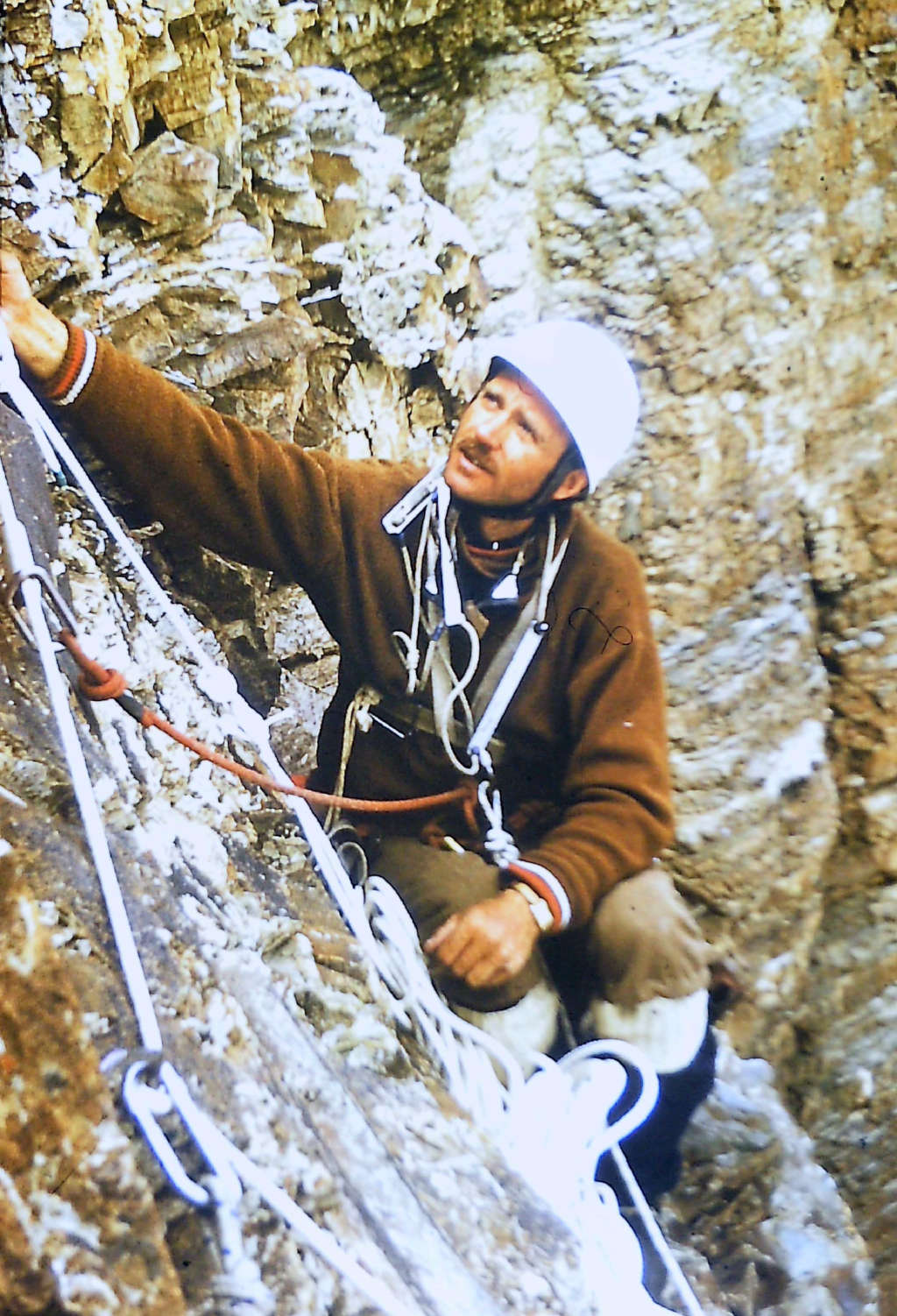 In the photo: O. Verba on the route
There were two first ascents to the peaks. One of them—in 1988, initiated by the National Academy of Sciences of Ukraine—was to Vernadsky Peak (as it was named), where a bust of the scientist was erected. It is very interesting to follow a route where no one has climbed before.
“Where nothing drives or flies, people walk”—about the friendly team that crossed the Muksu River in the Pamirs—a turbulent, capricious river flowing from the Fedchenko Glacier. To set up the crossing, it seems they spent three days trying to throw a stone tied to a rope across it, hoping it would get securely stuck so they could cross safely. They succeeded.
About Everest. By the way, O. Verba was Ukraine’s candidate for the USSR national team, which climbed Everest in 1982. The preparation lasted three years, but at the last moment some competition “came into play,” as he received an official letter from Yevgeny Tamm, the head of the Himalayan expedition, stating that according to medical indicators determined at the Center for Medical and Biological Research—where cosmonauts were also examined— Alexander Andriyovych’s body could supposedly function effectively at altitudes up to 8,000 m (Everest is 8,848 m). In other words, they “weeded out” the Ukrainian, even though based on physical performance on routes and climbs, he was among the top ten strongest.
Dangerous situations. They happened. For example, in the Caucasus, we were climbing Aday-Khoh (4,404 m) during a thunderstorm. "We were already near the summit; I was leading the way. Lightning struck the summit, a discharge ran down the slope, and I lost consciousness.” My friends saw it: the leader was thrown upward—and flew down the slope. We were lucky; they caught me on the rope, on the belay.
Another time—we were climbing Leningrad Peak (6,507 m) in the Pamirs, ascending a snowy slope, waist-deep in snowdrifts, and reached the ridge. "A crevasse opened above us, and the entire 1.5-kilometer slope slid down. We were swept in the avalanche for nearly 400 m down to the Great Pamir Plateau. In the slush, like a downhill skier, I tried to make skiing (or swimming) movements. We were lucky—we weren’t roped together, so we didn’t get tangled in the ropes. “When I landed—no one was there; a pole was sticking out here, a rope was sticking out there.” We dug each other out. Everything ended safely.
Regarding “we were lucky.” All mountaineers are modern, educated people, yet they believe in omens and talismans.
Once in the mountains, on his birthday, Oleksandr Andriyovych was given a trikon (a spike from a metal crampon), which became an amulet that protected him from attacks and misfortunes in the mountains. He still keeps it. He believes it truly saved him in critical situations.
Now. Lively, friendly, and always smiling—that’s how Oleksandr Andriyovych’s students and colleagues at the Department of Computer Science know him. He teaches the courses “Computer Logic,” “Computer Arithmetic,” and “Computer Architecture.”
It’s worth noting that this year marks a milestone for the athlete. He is entering the “golden age of wisdom.” His immediate plans include a trip to Andorra. It turns out that the conditions there are ideal for veteran skiers. What can be said about this? Envy him, join him, follow his example—the choice is yours. Respect him.
And to students and younger colleagues, the veteran never tires of repeating: go to the mountains, enjoy yourselves. The mountains aren’t exactly happiness, but they can stand in for it.