

The Sikorsky Challenge Additive Technologies Science Park is an integral part of the Sikorsky Challenge innovation ecosystem, which brings together the resources of Igor Sikorsky Kyiv Polytechnic Institute, the Sikorsky Challenge Innovation Holding, and the research, engineering, and business communities.
One of the Park’s priority areas is the design and manufacture of custom orthoses, adaptive devices, and assistive equipment for people with impaired limb function. At the same time, it is developing advanced manufacturing technologies, involving students and veterans in practical engineering activities, and cooperating with healthcare institutions, businesses, and charitable organisations. All these efforts are driven by a shared goal: creating the conditions for restoring Ukraine’s human capital.
We spoke with Nataliia Seminska, Director of the Additive Technologies Science Park and Candidate of Technical Sciences, about how engineering technologies, education, and partnership help achieve this goal.
– Nataliia Valeriivna, what are the main tasks facing the Additive Technologies Science Park today?
– Our main task is to turn modern engineering technologies into practical solutions that meet people’s needs. One of our key areas is the design and manufacture of custom orthoses, adaptive devices, and assistive equipment for people with impaired limb function as a result of injuries or illnesses. The war has significantly increased the demand for such solutions. However, I would like to emphasise that we are not directly involved in medical rehabilitation or prosthetics. That is the work of qualified healthcare professionals. Our role is an engineering one. We have the equipment, technologies, and specialists needed to create customised products tailored to individual needs. At the same time, the Science Park is about much more than equipment and manufacturing. We conduct research, involve students in real-world projects, cooperate with businesses, and develop educational opportunities for veterans. It is important to me that these areas do not operate independently but complement and reinforce one another.
– Why did you focus specifically on orthoses and adaptive devices?
– We began by studying the needs of healthcare institutions working with wounded people and realised that there were many individual needs for which no ready-made, mass-produced solutions existed. It is important to distinguish between prostheses and orthoses. A prosthesis replaces a missing limb or part of a limb, while an orthosis supports or stabilises an existing limb or helps improve its function. Another area involves adaptive devices and occupational therapy aids that help people carry out everyday activities. When developing these products, it is essential to take into account each person’s anatomical characteristics, functional limitations, and specific needs. This is where we saw opportunities to apply additive manufacturing technologies. However, we do not start by asking what can be printed on a 3D printer. First, we need to understand the problem that needs to be solved, and only then look for an appropriate design and technological solution. Sometimes even a relatively simple device can make a significant difference to a person’s everyday life. For us, that is what makes the result truly meaningful.
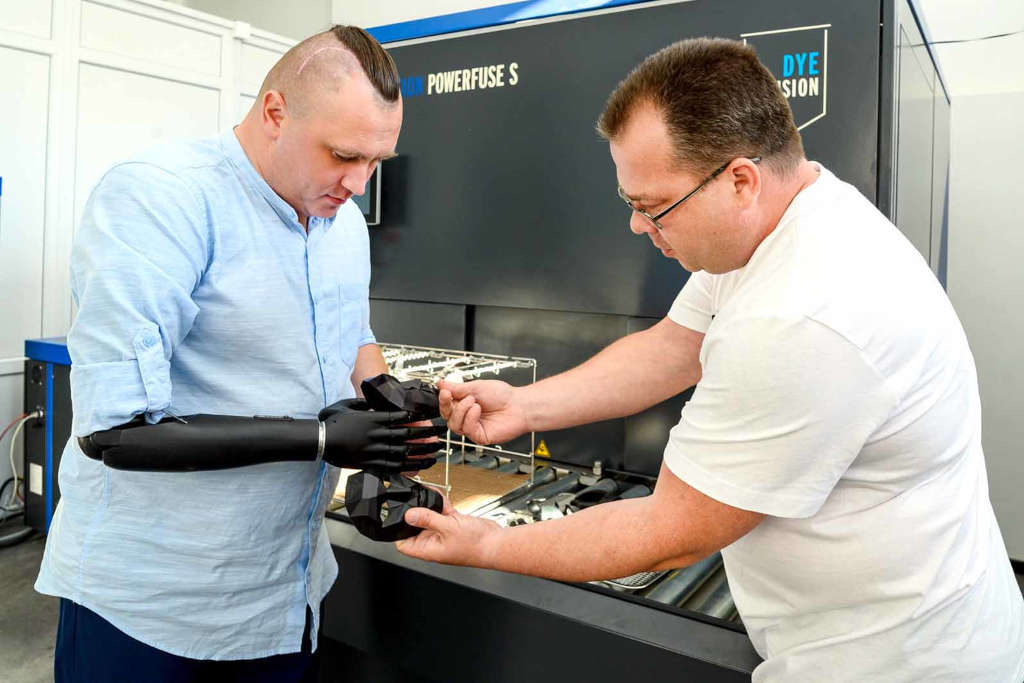 Pictured: Checking the fit and functionality of the product after post-processing.
– How did the idea of establishing the Science Park come about, and who helped make it a reality?
– In 2023, the KОLO Charitable Foundation approached the Sikorsky Challenge Innovation Holding with an initiative to support the development of technologies to help wounded people, including by drawing on the capabilities of Igor Sikorsky Kyiv Polytechnic Institute. The first step was to establish a Training and Innovation Centre for Prosthetics and Rehabilitation, one of whose objectives was to provide training and professional development for specialists in prosthetic rehabilitation. It soon became clear that implementing our own engineering developments would require a modern technological infrastructure. With the support of our partners and benefactors, we acquired an HP Jet Fusion 5200 industrial additive manufacturing system, post-processing equipment, 3D scanners, and other technological solutions. But equipment is only part of the story. We needed to prepare the premises, build the necessary infrastructure, assemble a team of engineers and technologists, establish production processes, and introduce a quality management system. In many respects, we had to build everything from scratch. I cannot say that all our processes are working exactly as we would like them to today. We are gradually gaining experience, revising our approaches, and improving the way we organise our work. That is a normal part of development. What matters is that a community of people and organisations has formed around the Park, bringing together those who are ready not merely to support individual projects but to develop this field together.
– How is the process of developing a customised product organised?
– It is a team effort involving a healthcare professional, an engineer, and the person for whom the product is being made. We work with hospitals, rehabilitation centres, and other healthcare institutions. It all starts with a specific request. A physical therapist or another authorised specialist identifies the person’s functional needs and defines the task for our team. We then take the necessary measurements and perform 3D scanning, create a digital model, develop the design, and produce a prototype. At this stage, we often use FDM technology. It allows us to check the product’s geometry, carry out fitting trials, assess comfort, and make any necessary adjustments. Once the design has been approved, the product can be manufactured using the industrial HP Jet Fusion system, which employs Multi Jet Fusion (MJF) technology and PA12 material. The subsequent stages include post-processing, quality control, fitting, and further adjustments if needed. Every product is unique, so there is no one-size-fits-all solution. Sometimes we have to modify the design several times and conduct additional fitting sessions. Naturally, this requires time and effort from the entire team. What matters to us is that the product should not only meet the technical requirements but also be comfortable and functional for the person using it.
– What are the main advantages of additive manufacturing technologies?
– First and foremost, they offer the possibility of personalisation. We can take individual anatomical features into account, create designs with complex geometries, and modify them without having to manufacture new conventional tooling. A digital model allows us to make changes relatively quickly and, if necessary, reproduce the product. However, I do not believe that 3D printing can replace all traditional manufacturing technologies. It is a tool with its own advantages and limitations. The quality of the final product depends on sound engineering design, the correct choice of material, technological parameters, and production quality control. That is why we devote considerable attention to training specialists, researching materials, and refining manufacturing processes. Our goal is not simply to produce individual prototypes, but to establish the conditions for the systematic production of high-quality products.
– Philanthropy is an important part of the Park’s work. How does it fit in with its other areas of activity?
– Our project had a social dimension from the very beginning. Thanks to the support of our partners, we were able to build infrastructure that enables us to manufacture customised products for wounded people free of charge. However, it is important to understand that this work requires ongoing resources. Equipment needs maintenance, materials have to be purchased, specialists need to be paid, and production needs to be developed. That is why, alongside our charitable activities, we cooperate with businesses, take on engineering and manufacturing contracts, and seek grant funding. Our priority is to develop a financially sustainable model that will allow us to advance our technologies and strengthen our team while continuing our charitable work. This is no easy task. We are still looking for the right balance between social projects, research, and commercial activities. But I am convinced that a social project should not have to rely solely on the constant search for charitable funding. It should gradually develop into a self-sustaining system.
– What challenges do you face?
– There are quite a few, actually. And I would not want to give the impression that we simply purchased the equipment, assembled a team, and everything immediately fell into place. One of the main challenges is training engineers. Modern equipment, on its own, does not solve anything. We need people who know how to operate it, understand the technologies, can design a product, and see it through to completion. We are gradually building our team and bringing in young professionals and students. They learn and gain experience. Of course, mistakes happen; sometimes we have to rework things or change our approach. But that is part of the process. Another challenge is cooperation between engineers and healthcare professionals. We come from different professional backgrounds, and sometimes we even interpret the same task differently. So we are learning to listen to one another and work together. A major area in its own right is the quality management system, technical documentation, and compliance with regulatory requirements. We have already made significant progress, but there is still a great deal of work ahead. What matters to me is that the team is gradually building up its own experience. We are now able to take on more complex tasks and have a better understanding of both our capabilities and our limitations. That, too, is one of the important outcomes of our work.
 Pictured: Orthoses and assistive devices created by specialists at the Science Park.
– The Science Park operates within a university environment. What role do students play in its activities?
– For me, this is one of the greatest advantages of our project. Students have the opportunity to work on real-world engineering challenges, use state-of-the-art equipment, and take part in developing products from the digital model stage right through to the finished item. This is more than just a practical training placement. Some students join the Park’s team, gain hands-on experience, and gradually develop into fully fledged professionals. Of course, young engineers need time to learn to work independently. We cannot simply assign a student a complex product to develop and expect a flawless result straight away. That is why it is essential to have experienced specialists on hand who can explain things, offer guidance, and help correct mistakes. We also support student projects and start-ups and involve young people in research. I believe that a university should provide not only theoretical knowledge but also opportunities to understand how that knowledge is applied in practice. The Science Park can offer precisely this kind of environment.
– Another area of your work is education for veterans. What role does the university play in this?
– For me, this is directly connected with the restoration of human capital. We talk a great deal about rebuilding Ukraine – its infrastructure, businesses, and economy. But who will do all this rebuilding? Without people, their knowledge, experience, and professional skills, it is impossible. The war has changed the lives of many Ukrainians. Today, a university must do more than simply train specialists: it must create opportunities for those who want to acquire a new profession, develop their skills, or pursue a different career path. This is particularly important for veterans returning to civilian life. At Igor Sikorsky Kyiv Polytechnic Institute, we are developing a master's programme for veterans, professional development courses, and opportunities to gain hands-on experience working with modern equipment. The Science Park is part of this environment. Here, people can not only acquire new knowledge but also apply it in real engineering projects, join a team, and see the results of their own work. Of course, we are still building this system. Not everything works as we would like it to. We need to adapt our educational approaches, take into account people's different backgrounds and experiences, and improve cooperation between the university's departments and units. But I am convinced that a university is uniquely positioned to bring together education, research, practical experience, and cooperation with businesses. And the most important thing is not the diploma or certificate itself. What matters is that, after completing their studies, people can see real prospects for their future.
– You use the term “rehabilitation through education”. What does it mean?
– I see education as one of the important tools for helping veterans return to active civilian life. Of course, we are not talking about replacing medical or psychological rehabilitation. It is about something else: rebuilding confidence in one's own abilities, acquiring new knowledge, adapting professionally, and returning to active participation in society. When someone comes to the university, they enter an environment where they can learn, communicate, work as part of a team, and develop their own ideas. It is particularly important that veterans feel they are not simply participants in a specific social programme, but full-fledged members of the university community. We want veterans to have opportunities to take part in engineering projects, master new technologies, acquire a profession, or start their own business. What matters to me is that veterans have the opportunity not only to receive support but also to contribute to creating new solutions. After all, education is not just about gaining knowledge. It is also about discovering a new environment, new opportunities, and new goals.
 In the photo: Learning through work on practical tasks
– You often speak about the need to build a sustainable system. What does that mean in practice?
– To me, sustainability means that the results of our work do not depend on a single benefactor, an individual, or a particular project. We already have modern infrastructure, equipment, a team, partners, and practical experience. Our task now is to make sure that all these elements work together as a single system. This means having well-established production processes, a quality management system, specialist training, cooperation with healthcare institutions and businesses, ongoing research, and stable funding. We want the solutions we have developed to be further improved, scaled up, and shared with other teams. Of course, we still have some way to go. But we already have a foundation on which to build further development. After all, the need for these technologies and specialists far exceeds what a single Science Park can provide.
– Who supports the development of the Science Park?
– First of all, I would like to point out that we are an integral part of the Sikorsky Challenge innovation ecosystem. The Sikorsky Challenge Innovation Holding, together with Igor Sikorsky Kyiv Polytechnic Institute, plays an important role in establishing and developing the Science Park. It was the combination of the university’s capabilities, engineering expertise, business involvement, and charitable support that made this project possible. Our partners include the Genesis for Ukraine Charitable Foundation, OBRIO and Appflame, EPAM, OLX, and the Embassy of the Czech Republic. Thanks to their support, we have acquired equipment, developed our technological and educational infrastructure, and created opportunities to launch new projects. I would also like to highlight our cooperation with healthcare institutions and rehabilitation centres. They help us understand people's actual needs and identify the challenges that our engineering teams need to address. For us, partnership is about much more than funding. It also means knowledge, experience, joint effort, and opportunities for growth. I greatly value the fact that a community of partners has gradually formed around the Park – one that is ready to support not only individual initiatives but also the development of the entire system.
– And finally, what do you consider the most important outcome of the Science Park’s work?
– Of course, there are tangible products, new technologies, and completed projects. But above all, it is about people. When one of our products helps someone become more independent. When a student gains practical experience and becomes an engineer. When a veteran finds a new professional path and an opportunity to fulfil their potential. These are different outcomes, but they are all interconnected. We can rebuild businesses, purchase state-of-the-art equipment, and create new infrastructure. But without people who are able to work, create, and grow, none of it will have any meaning. That is why, for me, what matters is not just how many products we have manufactured or how many projects we have completed. What matters is the opportunities people have gained as a result. I am convinced that the country cannot fully recover without restoring its human capital. And this is what I see as one of the key responsibilities of the university and the Science Park.
 Pictured: Developments from the Science Park are being used in rehabilitation.