

Slavutych Branch of Igor Sikorsky Kyiv Polytechnic Institute: History and Present Day
In the year marking the 40th anniversary of the Chornobyl Nuclear Power Plant disaster, the Slavutych Branch of Igor Sikorsky Kyiv Polytechnic Institute will also celebrate the 25th anniversary of its establishment. Today, the Branch plays an important role in educating specialists for Ukraine's nuclear power industry and related sectors, particularly in the fields of nuclear facility decommissioning, radioactive waste and materials management, environmental safety, and other areas. The editorial team of Kyiv Polytechnic invited the Acting Director of the Branch, Doctor of Technical Sciences, Professor, Academician of the National Academy of Sciences of Ukraine Anatolii Nosovskyi, to share the history and current activities of the Slavutych Branch.
"First and foremost, it should be noted that the Branch contributes significantly to improving the quality and effectiveness of education, teaching, and research in the region," Professor Nosovskyi begins. "The early 2000s marked a pivotal period for the residents of Slavutych, Ukraine's youngest city, founded in 1988. This period was closely linked to the Government's decision to permanently shut down the Chornobyl Nuclear Power Plant on December 15, 2000. Another milestone in the city's history was the establishment of the Slavutych Center for Higher Education and Research in 2000, created under a Presidential initiative to address the region's complex socio-economic challenges. A year later, in October 2001, the Slavutych Branch of the National Technical University of Ukraine 'Igor Sikorsky Kyiv Polytechnic Institute' joined the Center. The Branch was established pursuant to the Cabinet of Ministers' Directive No. 474-r of October 12, 2001, by Order No. 709 of the Ministry of Education and Science of Ukraine dated October 29, 2001, and Order No. 1-156 of the University dated November 5, 2001. The Branch owes its establishment largely to the efforts of Volodymyr Udovychenko, Mayor of Slavutych from 1990 to 2015; Mykhailo Zgurovskyi, Rector of Igor Sikorsky Kyiv Polytechnic Institute from 1992 to 2024; and Anatolii Nosovskyi, Acting Director of the Branch. Initially, the Branch offered degree programs in Computer Science and Human Health. Special emphasis was placed on integrating information technologies with the energy sector and on conducting research aimed at the rehabilitation of people affected by the consequences of the Chornobyl disaster."
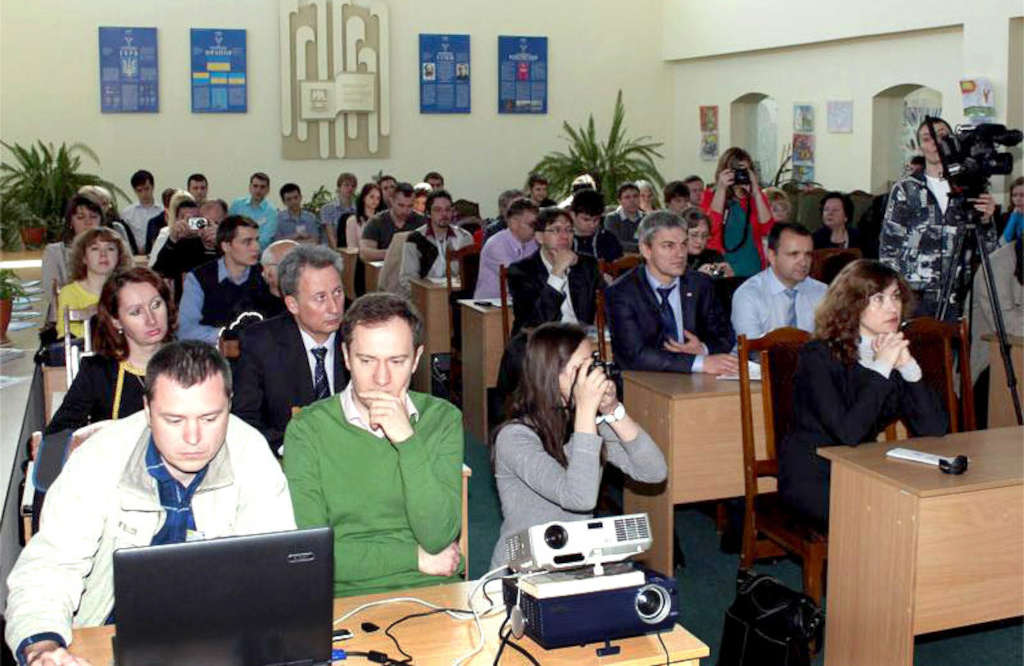 In the photo: The First International Scientific and Practical Seminar on Smart City Technologies in the 21st Century, Slavutych, April 2014.
Over the years, the Branch has significantly expanded its material and technical infrastructure. Through cooperation with the international educational network World ORT and the U.S.-based technology company Hewlett-Packard, it established a modern information technology laboratory equipped with advanced hardware, computer classrooms, and resource centers. Its educational and research activities have been further strengthened through numerous projects and initiatives, including the launch of the Hour of Code program in 2014 to promote computer programming among school students. Since 2014, the Branch has hosted the international scientific and practical seminar Smart City Technologies in the 21st Century. In 2016, it also founded the international conference INUDECO, which has become an important platform for knowledge exchange and international cooperation in the fields of nuclear and radiation safety.
The high quality of the educational process is ensured by the Branch's academic staff, whose expertise has shaped its scientific traditions and provided students with a strong professional education. Among the faculty members and researchers who have made a significant contribution to the Branch's development are Anatolii V. Nosovskyi, V.V. Chenkova, M.P. Pykhtar, V.K. Kuchynskyi, L.M. Salii, M.V. Savelieiev, I.S. Skiter, A.I. Savin, O.L. Nikolaieva, and O.V. Trunova.
Today, the Branch delivers a comprehensive range of educational and scientific activities, including pre-university training, professional development courses, scientific and practical events, and participation in international projects. These activities strengthen the University's institutional reputation, expand partnerships with higher education institutions, research organizations, industry representatives, and other stakeholders, and enhance the competitiveness of its academic programs within both the national and international higher education landscape.
It is worth noting that over the past 25 years, the philosophy of teaching scientific disciplines to future engineers and researchers at the Branch has undergone significant transformation. During this period, education has evolved from a knowledge-based model to a competency-based, practice-oriented, and student-centered approach. From the very beginning of the Branch's operation, modern teaching methods have been actively introduced, including active learning strategies, project-based learning, and the development of students' creativity, independence, and research skills.
In the training of IT specialists, particular emphasis has gradually shifted toward developing practical competencies, continuously updating course content, integrating digital technologies into the learning process, and fostering students' ability to engage in lifelong self-directed learning. The accumulated experience has been summarized in the collective monograph Models and Instrumental Tools for Supporting Academic Entrepreneurship.
An important milestone was the partial implementation of a dual education model in cooperation with the Educational and Research Institute of Nuclear and Thermal Energy of Igor Sikorsky Kyiv Polytechnic Institute and the State Specialized Enterprise Chornobyl Nuclear Power Plant under an agreement signed on September 14, 2023. Among other provisions, the agreement defines the rights and responsibilities of the Slavutych Branch as a participant in implementing the dual education model for specialist training.
"I believe it is also important to speak about the fundamental values, mission, and strategic principles that define the purpose of the Slavutych Branch as a structural unit of the University," Professor Nosovskyi continues. "Our value system is based on academic integrity, scientific rigor, safety, social responsibility, and sustainable development. The Branch contributes to strengthening Slavutych's identity as a scientific and technological center for nuclear energy. Its mission is to educate highly qualified specialists for the nuclear power industry and related sectors, particularly in the fields of nuclear facility decommissioning, radioactive waste management, environmental safety, information technology, and monitoring. The Branch continuously improves its pre-university training programs, expands professional development opportunities, introduces short-term educational programs, strengthens partnerships with Ukrainian and international institutions, and conducts both fundamental and applied research. A notable example of this work was the Branch's participation in Project No. 7122 of the Ukrainian Science and Technology Center (USTC), supported by the U.S. Department of State.
The Branch has established the necessary conditions for blended learning by using distance learning platforms, video conferencing technologies, and digital educational resources. Through cooperation with its partners, it has acquired modern equipment and instructional materials, making it possible to upgrade its technical infrastructure, partially modernize classrooms, demonstrate 3D models of the digital twin of a nuclear power plant and the New Safe Confinement–Shelter Object (NSC–SO) complex, provide access to electronic learning resources, and ensure uninterrupted operation during power outages through reliable Internet connectivity.
An important factor in maintaining the continuity of the educational process has been the support of the local authorities. In particular, the municipal administration provided the Branch with a power generator, enabling it to establish a Point of Invincibility at its leased educational facilities. This infrastructure ensures a stable electricity supply and uninterrupted Internet access during potential blackouts, allowing students to continue participating in online classes.
The Branch has established the necessary conditions for blended learning by using distance learning platforms, video conferencing technologies, and digital educational resources. Through cooperation with its partners, it has acquired modern equipment and instructional materials, making it possible to upgrade its technical infrastructure, partially modernize classrooms, demonstrate 3D models of the digital twin of a nuclear power plant and the New Safe Confinement–New Shelter (NSC) complex, provide access to electronic learning resources, and ensure uninterrupted operation during power outages through reliable Internet connectivity.
An important factor in maintaining the continuity of the educational process has been the support of the local authorities. In particular, the municipal administration provided the Branch with a power generator, enabling it to establish a Point of Invincibility at its leased educational facilities. This infrastructure ensures a stable electricity supply and uninterrupted Internet access during potential blackouts, allowing students to continue participating in online classes.
In accordance with the national standards for professional training, the Slavutych Branch offers continuing education programs for specialists in the energy sector. These programs form a comprehensive system of professional development for engineers and researchers. To support this initiative, the Branch has developed 12 two-level training programs covering the planning, design, and implementation of the safe decommissioning of nuclear power plants, the operation of monitoring and control systems for the New Safe Confinement, and the cybersecurity of nuclear power plant information and control systems.
All programs have undergone expert review and have been approved by the relevant departments of Igor Sikorsky Kyiv Polytechnic Institute. A comprehensive set of educational and methodological materials has also been developed, including specialized textbooks on key topics such as decommissioning planning, nuclear and radiation safety, radioactive waste management, physical protection, control systems, and cybersecurity.
A particularly significant achievement has been the publication of the bilingual textbook Decommissioning of Nuclear Power Plants, which summarizes current Ukrainian regulatory requirements alongside international best practices. The introduction of an English-language edition expands training opportunities for international specialists and supports the Branch's integration into the global educational and research community.
In response to a question from a Kyiv Polytechnic correspondent about what he would like to say to his colleagues who have remained committed to the Slavutych Branch of Igor Sikorsky Kyiv Polytechnic Institute, Anatolii Nosovskyi replied: "Any organization's success is determined by its people. The team that stood at the origins of establishing a higher education institution in Slavutych and continued to develop it ensured the Branch's growth and long-term success. I would like to express my sincere gratitude to the academic staff of our Branch for their dedication, professionalism, and significant contribution to the education of specialists and the advancement of science and higher education in the region. A particularly important role in this process was played by A.T. Babynets, Yu.P. Horho, V.M. Los, Yu.V. Polukhin, Yu.A. Popadiusia, L.M. Ryzhkov, I.S. Skiter, O.V. Trunova, M.P. Pykhtar, V.V. Medintsov, L.M. Salii, M.V. Saveliev, V.M. Shatalov, O.L. Nikolaieva, O.O. Zastavniuk, N.Ya. Sliozka, V.K. Kuchynskyi, V.V. Andrieiev, A.I. Savin, O.M. Bushma, S.M. Tarabrova, S.V. Suzanska, and V.A. Zinchenko. Most of them continue to ensure the continuity of our traditions and maintain the high quality of education."
"I would also like to express my gratitude to the staff of the administrative, management, and support units, whose coordinated work ensures the Branch's stable operation. I would especially like to acknowledge the contributions of L.O. Rybak, N.A. Kozhedub, L.V. Bieliaieva, T.F. Shalda, N.V. Salamatina, Z.P. Shykera, O.O. Salamatin, Ye.A. Antonov, O.P. Tolkach, V.P. Horokh, N.O. Falshovnyk, M.O. Shevchenko, and V.V. Holoburda.
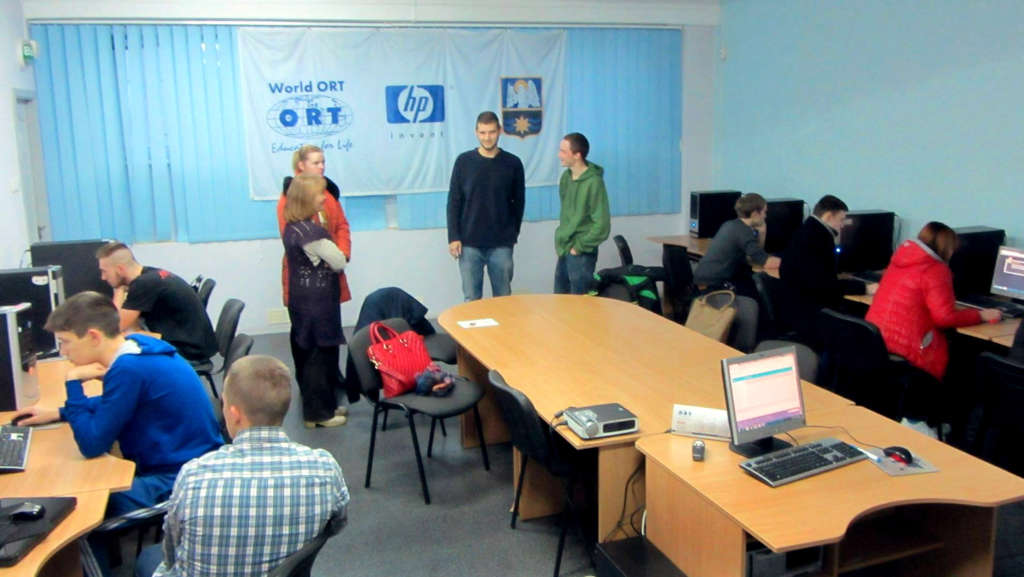 In the photo: Learning during the Hour of Code in the Slavutych branch, 2015.
Special appreciation should be extended to V.V. Chenkova for her significant contribution to the establishment of the Branch's educational system, as well as to L.V. Bieliaieva for her professionalism and dedication to ensuring the Branch's stable operation.
I would also like to recognize the work of the current Deputy Directors, M.P. Pykhtar and L.M. Salii, whose leadership has ensured effective management and the successful implementation of the Branch's strategic development priorities."
Anatolii Nosovskyi emphasizes that the Branch maintains strategic partnerships with leading employers and stakeholders in Ukraine's nuclear energy sector. Above all, this includes cooperation with the State Specialized Enterprise Chornobyl Nuclear Power Plant (SSE ChNPP), encompassing joint educational and applied research projects, practical training, internships, research in the fields of nuclear facility decommissioning and radioactive waste (RW) management, as well as public outreach and information activities. Cooperation with Energoatom Repair Service includes internship opportunities, joint educational programs, and participation in equipment modernization and maintenance projects. In addition, the partnership with the Institute for Safety Problems of Nuclear Power Plants of the National Academy of Sciences of Ukraine focuses on collaborative research, scientific conferences, seminars, and expert knowledge exchange.
The conversation with Anatolii Nosovskyi also addressed the 40th anniversary of the Chornobyl Nuclear Power Plant disaster. "In connection with this anniversary, the Branch has been actively participating in scientific, educational, and international events throughout 2026," he explained. "In particular, together with the Educational and Research Institute of Nuclear and Thermal Energy of Igor Sikorsky Kyiv Polytechnic Institute, we co-organized the 23rd International Scientific and Practical Conference for Young Scientists and Students, Contemporary Challenges in Scientific Support for the Energy Sector, in April. The conference showcased a range of educational and research achievements, including the presentation of the textbook Decommissioning of Nuclear Power Plants. In addition, a delegation from the Branch plans to participate in the INUDECO Conference, which is scheduled to take place in Poland in late November–early December 2026."
The editorial team of Kyiv Polytechnic congratulates the academic staff and students of the Slavutych Branch on its 25th anniversary and wishes them continued success in educating highly qualified professionals for Ukraine's energy sector.