

The international forum Innovations in Medical Engineering and its startup competition became an important event at Igor Sikorsky Kyiv Polytechnic Institute. The jury reviewed 58 ambitious projects addressing the needs of the military in rehabilitation and responding to pressing medical challenges. The best projects received support from partners and an opportunity to advance to the finals of the 14th International Festival Sikorsky Challenge 2025.
Among the winners was a project developed by Anastasiia Herasymenko, a fourth-year student at the Department of Translational Medical Bioengineering of the Faculty of Biomedical Engineering, under the academic supervision of Associate Professor Olena Holembiovska. The project is an innovative next-generation hydrogel wound dressing designed to treat wounds and burns, combining the unique properties of natural antiseptics with a modern biomatrix. The development demonstrates high effectiveness against resistant bacteria, biocompatibility, transparency, and the ability to create an optimal microenvironment for wound healing without the use of antibiotics.
In this article, Anastasiia Herasymenko, the project’s author, shares the story of how the idea was born and how it was brought to life.
Two years ago, during an ordinary lecture on biocompatible materials, a simple but important question was raised: “Why do most modern hydrogel dressings still fail to provide a comprehensive therapeutic effect?”
This came as a surprise. Biomedicine has made tremendous progress, so why is there still no affordable and effective comprehensive solution in such an important field as tissue regeneration?
The question remained open. I decided to conduct my own research. During a chromatographic analysis of hop iso-alpha acids—compounds seemingly far removed from medicine—I unexpectedly noticed their potential: “What if hop-derived iso-alpha acids could be used to create a multifunctional hydrogel dressing?”
I brought this bold idea to my academic supervisor, Olena Holembiovska, Candidate of Pharmaceutical Sciences. The idea also attracted the interest of Natalia Oliinyk, who later became the team’s Chief Financial Officer and saw not only its scientific novelty but also its commercial potential. This was how the KappaCore team came together, united by a shared belief in the potential of the product—“RanioPak,” a hydrogel dressing that combines moisturizing, antiseptic, and wound-healing properties.
“RanioPak” has a soft texture, adheres well to the skin, and has a pleasant hop aroma. It has already been tested on burns, wounds, tattoos, and after laser procedures. In all cases, the product noticeably reduced redness and irritation.
The product has significant potential to improve patients’ quality of life and to be used in healthcare facilities, particularly in geriatric care, burn centers, and military medicine.
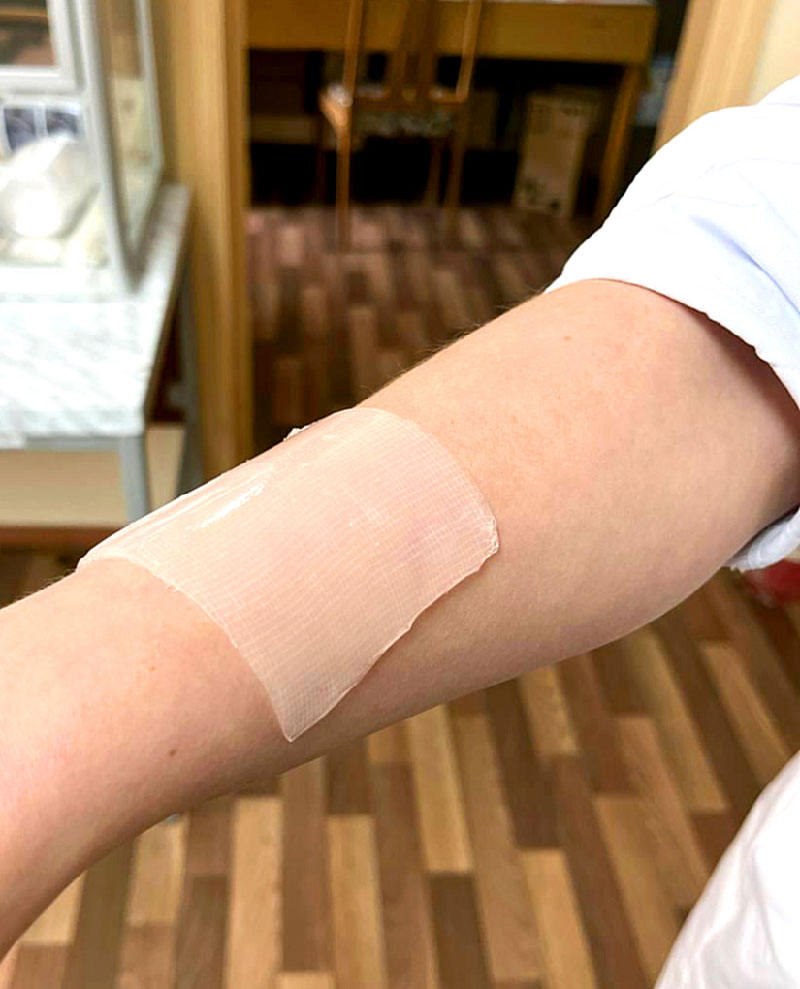 In the photo: RanioPak
Recently, our project won first place in the Tissue and Regenerative Engineering section of the international Innovations in Medical Engineering competition and received an award from the Genesis for Ukraine Foundation. This recognition opens new horizons for further development and scaling.
The KappaCore team is currently working to improve the formula and studying the controlled release of active substances. In the future, the team aims to create a “smart” dressing that responds to the condition of the skin and regulates treatment itself, adapting to the patient’s needs.
It is worth noting that today, students of the Faculty of Biomedical Engineering are not merely attending lectures. Starting from their second year, they acquire the knowledge and practical skills needed to contribute in laboratories, hospitals, and manufacturing facilities—and even to launch their own developments. This is not an exception; it is our reality. And “RanioPak” is an example of what today’s Ukrainian young bioengineers are capable of achieving.