

Kyiv Polytechnic has previously published articles about the technology for treating water contaminated with radionuclides that was developed by a team of researchers from Igor Sikorsky Kyiv Polytechnic Institute during the first weeks following the Chornobyl disaster.
The implementation of this technology played an important role in protecting the natural aquatic ecosystems of the Kyiv region from severe radioactive contamination and in safeguarding the health of countless people by reducing the risk of mutagenic processes and adverse genetic effects. One of the team's direct participants, Anatolii Krysenko, recalls how the group was formed and how it carried out its work.
Throughout its history, the Ukrainian people have continually fought for survival, freedom, independence—and ultimately, for life itself. Nearly every generation has faced its own defining conflict.
For our generation—the older generation—that struggle for survival came in the form of the Chornobyl disaster and the immense effort to mitigate its consequences.
The silent, terrifying, invisible force of the "peaceful atom," once it escaped human control, became a real threat to life on Ukraine's long-suffering land.
Yet the battle was fought not only against an invisible enemy. It was also a struggle against the factors that had allowed the tragedy to happen: bureaucratic arbitrariness, the suppression of truth born of ignorance, official deception, the inadequate professional competence of government agencies, and the lack of initiative and willingness to assume responsibility.
The two most serious nuclear accidents of the twentieth century were the Kyshtym disaster in the southern Urals near Chelyabinsk, Russia, and the Chornobyl disaster.
In 1957, during plutonium production at Kyshtym, an underground storage tank containing highly radioactive waste exploded. Approximately 10% of its contents was released into the atmosphere, contaminating about 23,000 km² of land inhabited by 270,000 people.
In Ukraine, the Chornobyl disaster is well known. By contrast, information about the Kyshtym accident remained classified for 30 years before it was made public.
What happened at Chornobyl could no longer be concealed only because the sharp increase in radiation levels was detected by the Scandinavian countries. The Soviet authorities were forced to respond, resorting to explanations and misinformation.
The Chornobyl disaster destroyed the reactor core and part of the building housing the reactor unit. The extremely high temperatures caused approximately 70 tonnes of radioactive material to vaporize, releasing an estimated 18.5 × 10¹⁷ Bq (50 MCi) of radioactivity, excluding noble gases.
During the first one to two months after the accident, the principal radioactive contaminants were noble gases and iodine-131 (¹³¹I)—the so-called "iodine period." It was during this critical phase that iodine prophylaxis for the population was urgently needed.
The release of radionuclides continued for ten days, forming a radioactive fallout pattern conventionally divided into the northern, western, and southern sectors.
The highest levels of cesium-137 (¹³⁷Cs) contamination were recorded in the northern and western sectors, while strontium-90 (⁹⁰Sr) contamination was most severe in the southern sector.
The total area contaminated with radionuclides across the territory of the former Soviet Union covered approximately 100,000 km², where about 4.5 million people lived.
The amount of the long-lived radionuclides strontium-90 (⁹⁰Sr) and cesium-137 (¹³⁷Cs) released into the biosphere was estimated to be 600 times greater than the release associated with the atomic bomb dropped on Hiroshima.
A distinctive feature of the Chornobyl disaster was the duration of the radioactive release. Unlike a nuclear explosion, where the release lasts only seconds, or the Kyshtym accident, where it continued for about an hour, the Chornobyl emissions persisted for several days. During this period, both the composition of the released radionuclides and the meteorological conditions changed continuously, significantly influencing the spread and deposition of radioactive contamination.
The Chornobyl disaster was also accompanied by the release of an exceptionally large number of hot particles into the atmosphere. These particles consisted primarily of oxides and carbide compounds formed during the high-temperature combustion of graphite and its fusion with alpha-emitting radionuclides. Although alpha particles have very low penetrating power and therefore pose little danger outside the body, they become extremely hazardous when inhaled or ingested through contaminated food, water, or air. Because of their high ionizing capacity, they damage living cells and can cause cancer, leukemia, and severe internal tissue injuries.
The Chornobyl disaster destroyed—or forever changed—the lives of thousands of people. I can speak from personal experience. While studying at the institute, I began working in the Radiochemistry Laboratory (the chemistry of radioactive elements) at the Department of Physical and Colloid Chemistry of Igor Sikorsky Kyiv Polytechnic Institute during my first year. It was a modern, well-equipped laboratory headed by Yurii Yakovych Fialkov, who at that time was the youngest Doctor of Sciences at the university. He later became Head of the Department of Physical and Colloid Chemistry, founded a distinctive scientific school, and gained recognition across Europe for his research in the field of non-aqueous systems.
By the time I graduated from the institute, I had essentially completed my Candidate of Sciences dissertation and had nearly a dozen articles published in scientific journals.
In the early 1980s, the Radiochemistry Laboratory established a group of young researchers led by Yurii Arutiunovych Karapetian, a gifted student of Professor Fialkov. I was a member of this group, where we worked on developing the theory of non-aqueous solutions and investigated the mechanisms of electrical conductivity through the so-called prototropic (proton) and halogenotropic transport mechanisms. At the same time, we carried out applied research on the development of non-aqueous lithium-based systems for high-capacity, heat-resistant, and long-life electrochemical power sources.
We collaborated with strategic state enterprises and the leading research institutes for electrochemical power sources in the former Soviet Union.
The work of our research group was classified at the highest level of secrecy and redirected to support the military-industrial complex.
Yurii Arutiunovych Karapetian completed his Doctor of Sciences dissertation under the classification "Secret." We clearly understood the theoretical and practical potential of further developing research on non-aqueous systems—not only for creating advanced electrochemical power sources, but also for producing ultra-pure rare-earth metals, developing metal coatings, and designing biological systems. Topics for future doctoral dissertations were outlined in detail, and preparations had begun for establishing the first Institute of Non-Aqueous Solutions in the former Soviet Union.
Then came the Chornobyl disaster, with its catastrophic consequences and unprecedented challenges. Using our radiological research equipment, the laboratory monitored the condition of the environment, measured radiation levels in the air, dust, and water, and collected samples throughout Kyiv.
On April 29–30, 1986, we recorded a sharp increase in radiation levels in the park area of Igor Sikorsky Kyiv Polytechnic Institute. Unofficially, we prepared recommendations and safety guidelines for the staff of the Faculty of Chemical Engineering and the university to help reduce the harmful effects of radioactive contamination and radioactive dust aerosols. Incidentally, it was not until May 6, 1986, that the Minister of Health of the Ukrainian SSR publicly announced essentially the same recommendations on television.
The authorities' ten-day silence about the potentially devastating consequences of the Chornobyl disaster, together with their failure to implement urgent public health measures—most importantly, mandatory iodine prophylaxis—should be regarded not merely as professional negligence but as a deliberate act of criminal concealment.
During a personal conversation, Professor Leonid Petrovych Kinzelskyi, who served as the Chief Radiologist-Oncologist of the Ministry of Health of Ukraine at the time of the Chornobyl disaster, told me that he had been forbidden to speak publicly about iodine prophylaxis in the first weeks after the accident. This restriction was imposed on an outstanding scientist whose medical methods saved nearly all of the first responders who remained in Kyiv rather than being transferred to Moscow. It is also worth noting that until his death in 1999, Professor Kinzelskyi faced relentless criticism and pressure from Soviet officials in Moscow. Those same authorities had repeatedly blocked the implementation of his treatment methods for critically ill patients. Their actions were driven by envy of the Ukrainian scientist's success, personal ambition, and hostility toward Ukrainian achievements. Despite the risks to his career, he remained committed to his medical principle until the very end: treating patients was not simply a profession but a moral duty, and saving dozens—or even hundreds—of lives was an obligation he never abandoned.
The people of Ukraine highly honored the outstanding oncologist Leonid Kinzelskyi, who saved the lives of many Chornobyl liquidators—including my own. In 2021, he was posthumously awarded the title of Hero of Ukraine.
According to the materials of the criminal case against former leaders of Ukraine, which argued in defense of the suspects accused of abuse of power and official misconduct, the leadership of the Ukrainian SSR and the republic's civil defense authorities were, in practice, deprived of the ability to make independent decisions. All matters related to determining the causes of the Chornobyl disaster, ensuring radiation safety, evacuating the population, and managing the response to the accident were decided only after consultation with Moscow. At the same time, on the eve of the May Day demonstrations, the republican leadership received instructions stating that it should act in accordance with the prevailing radiation situation.
By the end of April 1986, it had become clear that radioactive contamination had first reached the Ukrainian capital on the wheels of vehicles arriving from the affected zone, and that this process was ongoing and would continue. The Kyiv City Sanitary and Epidemiological Station urgently informed the city authorities that the entry of contaminated vehicles had to be stopped. Otherwise, it warned, the contamination could become so severe that the population might have to be evacuated.
Radiation monitoring checkpoints were established at the eight main entry points to Kyiv. Vehicles were washed directly on the roadside, and the contaminated wash water carried radionuclides into the unprotected natural environment.
During those first days after the Chornobyl disaster, the already devastating consequences of the accident threatened to escalate into a widespread environmental catastrophe. In particular, there was a serious risk of large-scale contamination of both surface water bodies and underground aquifers. As a result, extensive water protection measures were undertaken in the contaminated areas, and every possible source of pollution was isolated, with particular emphasis on safeguarding drinking water resources.
On the approaches to Kyiv, construction began urgently on the Transport Decontamination Stations. These facilities were designed to include asphalt-paved service areas, elevated washing platforms for vehicles, concrete or steel reservoirs with capacities of 50, 100, or 200 cubic meters for collecting contaminated wastewater, and integrated water treatment systems.
However, the volume of traffic was so intense that the storage tanks at the Transport Decontamination Stations filled up within just two or three weeks. The contaminated water could not be treated because the construction of the treatment facilities had been delayed and required time that simply was not available. A critical situation was rapidly approaching. Traffic from the contaminated zone was on the verge of being halted. Stopping vehicle movement would have meant interrupting the delivery of urgently needed supplies to Chornobyl. The Civil Defense Headquarters found itself in an extremely difficult position. The crisis demanded unconventional solutions. The leadership of Kyiv and the city's Civil Defense authorities were prepared to consider any viable proposal. Such a proposal came from Igor Sikorsky Kyiv Polytechnic Institute researchers Oleksandr Petrovych Shutko and Anatolii Dmytrovych Krysenko. Soon afterward, we were joined by our colleague Vitalii Pavlovych Basov.
It is worth noting that we were already familiar with the problem of removing radionuclides from wastewater. At that time, Oleksandr P. Shutko headed the Laboratory of New Chemical Reagents for Water Treatment, while Vitalii P. Basov and I specialized in radiation chemistry of solutions. All three of us had completed our dissertations at the Department of Physical and Colloid Chemistry of Igor Sikorsky Kyiv Polytechnic Institute.
It is often said that success comes to those who are prepared for it. Our many years of experience as radiochemistry researchers enabled us to assess the radionuclide composition released from the nuclear reactor. Most of the contaminants consisted of short-lived isotopes that would decay within a matter of days, which significantly simplified the process of treating the radioactive wastewater.
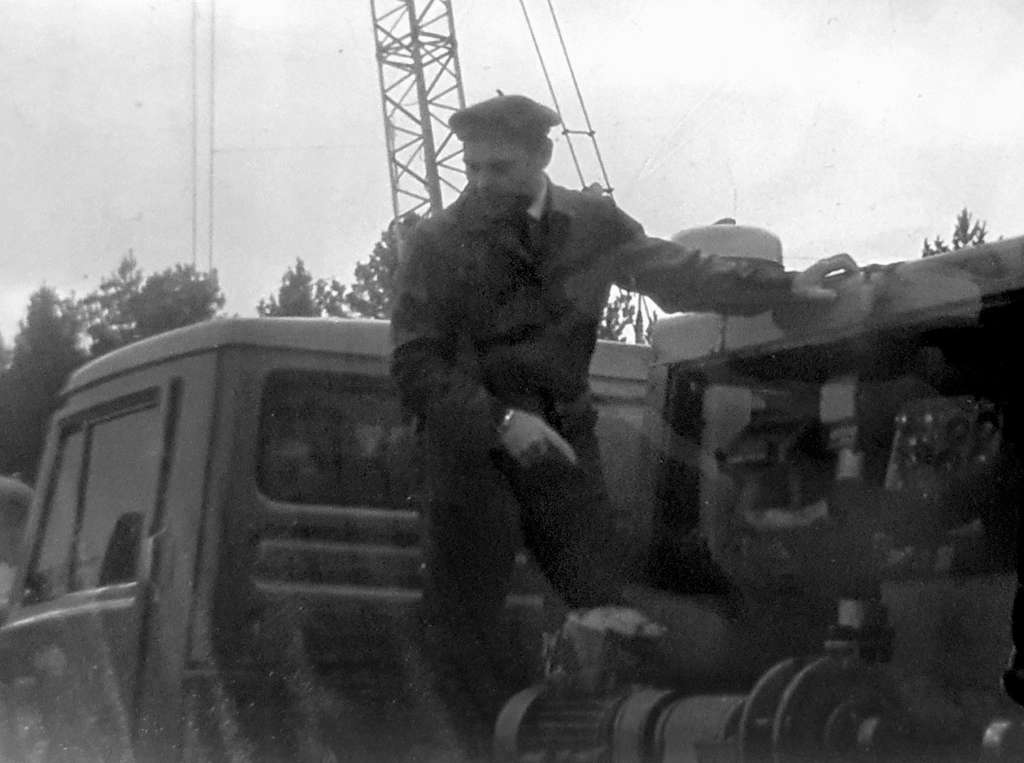 In the photo: V.P. Basov near the flow meter for dosing reagents
I was reminded of the saying: "There are no old problems—only new approaches to solving them." That was exactly the case. After determining the radionuclide composition of the contaminated water, we developed an effective reagent formulation within just a few working days and designed a mobile water decontamination unit (URDV-1) mounted on a KrAZ truck. The system was rapidly assembled at the Artem Production Association and the Leninska Kuznia Shipyard.
The technology we proposed did not require dedicated water treatment facilities. The mobile unit delivered the reagents and carried out the necessary treatment operations directly on site. Water decontamination was performed inside the storage tanks themselves. Within 1.5 to 2 hours after the contaminated wastewater had been treated, the radioactive material settled to the bottom, and after sedimentation the decontaminated water met the permissible concentration limits established by regulatory standards.
The effectiveness of this technology was tested at the Institute for Nuclear Research of the National Academy of Sciences of Ukraine. The project received a positive evaluation and was recommended for practical implementation. The Kyiv Civil Defense Headquarters established the Water Decontamination Group, which included four researchers: Oleksandr P. Shutko (the group's principal scientific coordinator), Anatolii D. Krysenko, Vitalii P. Basov, and postgraduate researcher Leonid P. Malakhov. The team also included Sanitary and Epidemiological Service radiologist V. K. Kovtunenko, along with drivers and technical operators—a total of ten people. The group's work was greatly supported by Civil Defense officers H. A. Kulaiev, B. H. Petrashchuk, O. A. Burovenko, and V. F. Zinkin, whose contribution was invaluable.
Thus began our difficult routine of daily deployments to Chornobyl sites. As radiochemistry researchers, we were fully aware of the risks associated with working in areas contaminated by radiation. Yet this was a moment in history that called upon us to serve others. It was a time of putting scientific ideas into practice, of dedication, and of extraordinary commitment. We were guided by humanitarian principles and understood our responsibility not only to our contemporaries but also to future generations—to the lives of our children and grandchildren, who would continue to live on this land.
Throughout 1986 and 1987, the Water Decontamination Group worked at Transport Decontamination Stations in Kyiv Region, at vehicle decontamination sites within the 30-kilometer exclusion zone, on equipment operated by the South-Western Railway, and in Belarus.
Within the 30-kilometer exclusion zone, which was administered by the Soviet Ministry of Medium Machine Building, elements of our technology were also introduced into practice.
The work of the researchers from Igor Sikorsky Kyiv Polytechnic Institute was widely covered by the central Soviet press, including Pravda, Pravda Ukrainy, and other leading publications. Our method became officially known as the "Kyiv Polytechnic Institute Technology." Two scientific documentary films were produced about our work: Kyiv's Radiation Shield (1987) and Chornobyl: It Is Only the Beginning (2016). Our team became well known throughout the Soviet Union, and specialists from Belarus visited us to learn from our experience, later adopting our technology there as well.
During the period of our work in Kyiv Region alone, approximately 50,000 cubic meters of highly radioactive wastewater were decontaminated. As a result, it became unnecessary to construct the network of expensive stationary treatment facilities that had originally been planned for the Transport Decontamination Stations in Kyiv and Kyiv Region. This saved the state more than 18 million Soviet rubles (at 1986 prices)—an enormous sum at the time.
In the years that followed, the technology for treating radionuclide-contaminated wastewater and the mobile decontamination equipment developed by specialists at Igor Sikorsky Kyiv Polytechnic Institute were adopted by the country's Civil Defense units.
In 1987, the project was awarded Gold, Silver, and Bronze Medals at the USSR Exhibition of Achievements of the National Economy (VDNH), and in 1989 it was nominated by the institute for the State Prize of Ukraine in Science and Technology.
Assessing the contribution of the Igor Sikorsky Kyiv Polytechnic Institute research team to the response to the Chornobyl disaster, it is important to emphasize that the group developed the most practical solution for treating extremely large volumes of water heavily contaminated with radionuclides. Their work also ensured the uninterrupted operation of the transport corridor linking the 30-kilometer exclusion zone with the rest of the country.
The achievement went beyond simply eliminating one source of contamination affecting the Kyiv ecosystem. It fundamentally changed the strategy for protecting the environment from large-scale radioactive pollution, particularly the contamination of groundwater resources.
A number of measures implemented to protect Kyiv's ecosystem—including intensive washing of city streets, the removal of fallen leaves in 1986, and the regular cleaning of residential and public buildings—played an important role in significantly reducing radionuclide contamination and radiation exposure caused by aerosols containing long-lived radionuclides and radioactive "hot particles." Today, the environmental radiation background no longer poses a threat to the population.
Far more harmful are various forms of chemical pollution, as well as radiophobia, which can lead to chronic stress. Such stress may contribute to immune system disorders and genetic mutations, potentially increasing the risk of cancer.
In addition to achieving substantial savings in material and financial resources, these efforts helped protect the health and, most importantly, the lives of many hundreds—or perhaps even thousands—of people of reproductive age who had originally been expected to work in the radioactive zone on construction projects and on the installation and maintenance of water treatment facilities.
At the end of 1987, the Water Decontamination Group completed its mission and was officially disbanded. Each of its members returned to their primary professional responsibilities.
At the beginning of this article, I wrote that Chornobyl either destroyed or profoundly changed the lives of many people. During our nearly eighteen-month Chornobyl "odyssey," Moscow, having recognized the strategic importance of the field, established the first Institute of Nonaqueous Solutions in the Soviet Union, located in Ivanovo. Funding for the development of advanced electrochemical power sources, which had been carried out by Yurii A. Karapetian's research group in the Radiochemistry Laboratory at Igor Sikorsky Kyiv Polytechnic Institute, was discontinued. Our scientific ambitions and long-term plans became impossible to realize. Was it simply fate—or one of its unexpected turns? Those who hesitate often lose their opportunity.
Yet life goes on. For researchers and other creative professionals, periods of great pressure—or even extreme circumstances—can sometimes become unexpected turning points. That was true during the dramatic days of the Chornobyl disaster, when we confronted the crisis at the Transport Decontamination Stations, and it remained true in the years that followed. The work our team carried out in the Chornobyl zone, driven largely by a sense of public service, ultimately made many of our future scientific achievements possible.
As the saying goes, "Bright stars follow remarkable trajectories." Oleksandr P. Shutko went on to earn his Doctor of Science degree. The work carried out by the Igor Sikorsky Kyiv Polytechnic Institute research team during the Chornobyl response became known at the highest levels of the Soviet leadership, helping pave the way for the establishment of Ukraine's first university department dedicated to industrial ecology. Oleksandr P. Shutko became its founding head. Nearly four decades later, the department continues its work, having trained generations of young researchers and environmental engineers specializing in industrial ecology and environmental protection. In many ways, the department stands as a lasting tribute to the group of Igor Sikorsky Kyiv Polytechnic Institute researchers who were among the university's first participants in the response to the Chornobyl disaster.
Forty years have passed since those tragic days of Chornobyl. Countless articles, books, memoirs, documentaries, and feature films have been devoted to them.
My own chapter in the history of Chornobyl remains vividly clear in my memory. With time, names may fade, but I still remember the faces of the people I met and worked alongside, and the choices they made. Amid the turmoil of those days, I recall no negative personalities. Those who lacked courage simply stayed hidden.