

An exhibition by renowned Ukrainian artist Vasyl Klymyk was held in April at the Hryhorii Synytsia Art Gallery of the Center for Culture and Arts of Igor Sikorsky Kyiv Polytechnic Institute.
“The exhibition features 30 paintings. Among them is one Slavic Madonna, while the rest are still lifes and landscapes,” said Viktoriia Tiotkina, Director of the Hryhorii Synytsia Art Gallery, before the official opening. “This artist is distinguished by his profound spirituality and exceptional mastery. He is not only a painter but also an architect and a poet, and this spirituality is deeply reflected in his work. We are truly fortunate to welcome such an artist to our gallery. He is a realist, and his realism is timeless—it has always been, and will always remain, accessible and meaningful to every viewer.”
Vasyl Klymyk’s paintings are rich in symbolism and deeper meaning. They invite careful, thoughtful viewing, as a quick glance may cause the viewer to overlook important details. This is especially evident in his still lifes. A striking example is the painting that gave the exhibition its title, The Purposefulness of Being, which also appears on the exhibition poster. It depicts a bust of the philosopher Epicurus, a stack of books with the authors’ names visible on their spines, a pot filled with paintbrushes, several apples, and a glass of wine. Interestingly, the artist subtly rendered the face of the famous ancient bust to resemble his own. This is not an act of vanity—Vasyl Klymyk genuinely bears some resemblance to the ancient Greek philosopher—but rather a discreet declaration of his affinity with Epicurus’ ethical philosophy. During the exhibition opening, the artist even quoted the philosopher’s famous words from his Letter to Menoeceus: “It is impossible to live pleasantly without living wisely, honorably, and justly; and it is impossible to live wisely, honorably, and justly without living pleasantly.” In this sense, The Purposefulness of Being, together with several other works displayed in the exhibition, can be viewed as a contemporary continuation of the allegorical tradition that was widespread in European painting of previous centuries, where the depicted objects and figures conceal abstract ideas and philosophical meanings.
As a painter, Vasyl Klymyk draws primarily on the technical achievements of the classical tradition. This is reflected in the precision and refined smoothness of his brushwork, at times achieving an almost illusionistic rendering of reality, as well as in his carefully constructed and well-balanced compositions. The romantic realist depiction of the external world in his paintings reflects not only the artist’s personal vision and understanding of art but also pays tribute to the formative period of his creative development. Its roots lie in his childhood in the historic town of Chudniv in the Zhytomyr region and in his first drawing lessons at the art studio of painter Viacheslav Yankovskyi.
During the exhibition opening, Vasyl Klymyk spoke at length about his childhood, adolescence, and school years. Although he was born in 1946 in the distant city of Cherepovets, where his father, a military engineer, was stationed at the time, the years that shaped him as both a person and an artist were spent in Chudniv and later in Kyiv.
His creative talents became evident already during his school years, and in a remarkably wide range of fields. Vasyl wrote poetry—something he continues to do to this day, and at a highly accomplished level—as well as prose, studied music, and was fascinated by astronomy. Above all, however, his greatest passion, which eventually became his lifelong vocation, was drawing. Not only was he deeply devoted to it himself, but he also inspired many of his classmates to share his enthusiasm. At the exhibition opening, his close childhood friend, renowned surgeon and distinguished personality Volodymyr Ryzhak, warmly recalled their school years together. He even read some of Klymyk’s childhood poems—remarkably mature works that hardly seemed to have been written by a teenager—and remarked: “I came here today not only to see this wonderful exhibition. I came to reconnect with my childhood and youth, because this was the person who first introduced me to the world of art.”
After graduating from school, Vasyl Klymyk enrolled in the Faculty of Architecture at the Kyiv Civil Engineering Institute (now the Kyiv National University of Construction and Architecture). After all, every architect is, to a greater or lesser extent, an artist, which is why applicants to the faculty are required to pass entrance examinations in drawing and composition. In these disciplines, Vasyl was exceptionally fortunate to have an outstanding mentor. At the institute, he studied drawing and painting under the guidance of the eminent Ukrainian artist Yurii Khymych, a master of the architectural landscape, who treated his gifted student with great care and encouragement. Significantly, Khymych’s own artistic style differed fundamentally from Klymyk’s, yet the teacher never sought to impose his manner of painting, instead allowing his student to develop along his own creative path.
After graduating from the institute, Vasyl Klymyk spent some time working in Tashkent, which was then being rebuilt after the devastating 1966 earthquake. Before long, however, he realized that he could not live without Ukraine and returned to the land that had become his true home. He found work in Kyiv and later moved to Vyshhorod, where he served as the district architect. Subsequently, he returned to the Ukrainian capital to work as a designer at the Khudozhnyk Association before dedicating himself fully to independent creative work.
Vasyl Klymyk is known not only as an easel painter but also as a monumental artist. Together with his friend Stanislav Voitsekhovskyi, he participated in painting the Church of St. John the Baptist on Harmatna Street in Kyiv. He is also recognized as an architect and sculptor, creating distinctive stelae, bas-reliefs, sculptural compositions, and memorial monuments in Vyshhorod, as well as in Kyiv and other cities across Ukraine. Several monumental works that he authored or co-authored have become widely known. Among them are the monument to Valerii Lobanovskyi at the Dynamo Sports Complex in Kyiv; the memorial to the Heroes of the Liutizh Bridgehead in the village of Novi Petrivtsi; the memorial to Prince Sviatoslav in Stari Petrivtsi; the Symbol of Peace memorial and the interior designs of the Battle for Kyiv in 1943 Museum-Reserve; the monument to Saints Borys and Hlib; and the memorial to the liquidators of the Chornobyl Nuclear Power Plant accident in Vyshhorod.
Returning to Klymyk’s paintings, it should be noted that he creates far more than landscapes and still lifes. His body of work also includes portraits, historical compositions, and even icons. The exhibition therefore presented only a small selection of his artistic legacy. Yet even this limited display featured works of remarkable beauty and emotional depth. Among the highlights were the majestic trees in Oaks, the contemplative landscape Over the Desna, the almost classically composed and atmospheric still life Bouquet for the Feast of the Saviour, and Datura and Rose, a still life that, among other objects, features a violin.
The presence of the violin in his paintings is no coincidence. Klymyk has a deep love of music and, as he himself explained, he paints while listening to it. In his view, music should always accompany the artist—it is an essential part of the creative process. Without it, he believes, true creativity cannot exist. It was therefore fitting that, during the exhibition opening, he expressed what sounded like his artistic credo: “There is both good and evil in the world. But the Muse must prevail. Reason must overcome every adversity.”
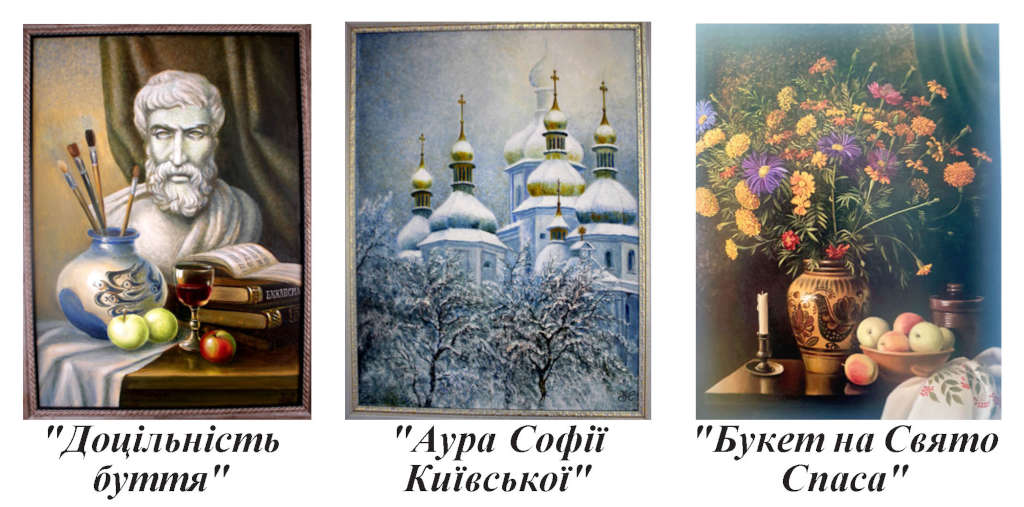 In the photo: Works by Vasyl Klymyk at the Central Museum of Fine Arts